(go
to KOMUGI Home) (go
to WIS List) (go
to NO.76 Contents)
Scab
Scab is an important disease in China with its own characteristics.
It prevails in the middle and lower reaches of the Yangtze valley,
coastal areas in southeastern China and eastern parts of Helongjiang
province with a severe epidemic nearly once every four years. Since
1950's more than 100 thousand accession-times of wheat materials have
been tested against scab isolates by Shanghai AAS and its partners
and none is found immune or highly resistant to the disease. Only a
very few landraces such as Liyang Wansuibai, Pinghu Jianzimai,
Wengzhou redbeardless, etc. are found to be resistant to the
extension of infection. But these landraces possess very poor
agronomic traits and can hardly be used in breeding. Fortunately in
1970, a relatively resistant (to extension) variety known as Sumai 3
was developed by Suzhou Prefectural Agricultural Research Institute
from a cross of two susceptible varieties (Funo/Taiwan). Since then
numerous crosses were made between Sumai 3 and various improved
varieties, and a series of new cultivars were developed and released
for commercial production but rarely their resistance could surpass
that of Sumai 3 (Liu et al 1992). Recently breeders from Fujian
Agricultural College has produced some new improved wheat lines
designated as Fan 60096 and the like from Jingzhou 1/Sumai 2 (a
sister line of Sumai 3) whose resistance to scab is slightly better
than that of Sumai 3 (Wang et al 1992). Although their difference in
resistance to extension of infection is statistically significant yet
such a small improvement is not enough to enhance yield
stability.
There are arguments regarding the mode of inheritance in varietal
resistance to scab. Most authors recognise it is polygenic in nature.
Monosomic analyses of scab resistance in Sumai 3 showed that many
chromosomes were involved with differential contributions (Li and Yu
1990, Yu 1990). A study of gene actions on scab resistance by
generation means analysis from biparental crosses between the
susceptible and a series of varieties with differenct degrees of
resistance indicated that although additive effect was of primary
importance, dominance should not be neglected and epistasis was
unimportant (Wang et al 1992). But some authors provided evidence
that scab resistance was controlled by a few major genes with a
certain number of modifiers, since it usually showed in F2
a segregation pattern of two peaks with one large and one small (Zhou
et al 1987, Bai et al 1990). The discrepency may be attributed to the
ways of expressing the infection indices and related also to the fact
whether infection data are taken at various stages of disease
development or not. If observations are taken in a dynamic pattern
then the conclusion would be polygenic; but as far as the sympton of
rachis infection is concerned it is of major genes inheritance (Li
and Yu 1990).
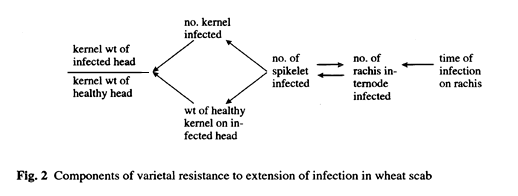
A study on the components of varietal resistance to scab extention of
infection through path analysis showed that yield loss depended on
the number of kernels infected by the fungus and the rate of
reduction in kernel weight from disease-free kernels on the infected
head, the first component playing a more important role. Both of them
then were affected by the number of spikelets infected which, in
turn, was influenced by the number of rachis internode infected and
the time of infection on the diseased head. Their relation is shown
in Fig.2.
<--Back |-->Next
(go
to KOMUGI Home) (go
to WIS List) (go
to NO.76 Contents)