Y.A. AL-SAHEAL
Department of Agronomy and Range Science, Gassim College of Agriculture, King Saud University, SAUDI ARABIA
Triticum aestivum L. (2n=6x = 42 ; AABBDD) offers some unique opportunities for the induction and exploitation of mutations of agronomic value. Though some earlier workers like STADLER (1930) were sceptical about the use of mutation breeding in grain crops, some interesing mutants have been induced in bread wheat (LARIK 1978 a, b, 1979 ; SIDDIQUI & ARAIN 1974). Chromosome anomalies such as translocations, deletions and duplications have been frequently observed in treated populations of several crop plants (LARIK 1975 ; LARIK et al. 1981, 1982). The present study reports meiotic anomalies and pollen sterility induced by EMS in three important hexaploid wheat varieties of Saudi Arabia and discusses their significance with reference to genetics and plant breeding.
Material and Methods
Homogeneous seeds of three bread wheat cultivars namely ; Al-Samma, Maaya and Yocorojo were treated with different concentrations of ethyle methane sulphonate (EMS) with different durations in Rabi 1983. Treated seeds along with control were sown in pots in a complete randomized design in a greenhouse of the Department of Agronomy and Range Science, Gassim College of Agriculture, King Saud University, Saudi Arabia. EMS treatments are given as below :
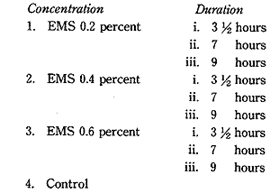
Immature spikes from treated and control plants were fixed in Carnoy's (6 : 3 : 1) solution (SNOW 1963). Analysis of different stages of meiosis were done at MI. Pollen fertility was determined by staining pollen grains in a solution introduced by ALEXANDER (1969). The data on seven meiotic parameters were analysed statistically using the General Linear Models (GLM) procedures of SAS (HELWIG & COUNCIL 1979). The least significant difference (LSD) at the 0.05 probability level (LSD0.05) is reported for testing means of each parameter.