With the interest in the quality, T. monococcum, T. dicoccum, T. vulgare, T. Spelta, synthesized 6x wheat and Aegilops species with D-genome were submitted to the analyses.
The appearance of the loaf of Ae. squarrosa was poorer than T. vulgare, but when mixed with T. vulgare as to contain 11% protein, the loaf was soft as T. vulgare. The taste of the bread of Ae. squarrosa was good.
Nuclear Substitution
Kihara's method (Kihara 1951) of nuclear substitution and restoration by successive backcrosses can be understood as follows:
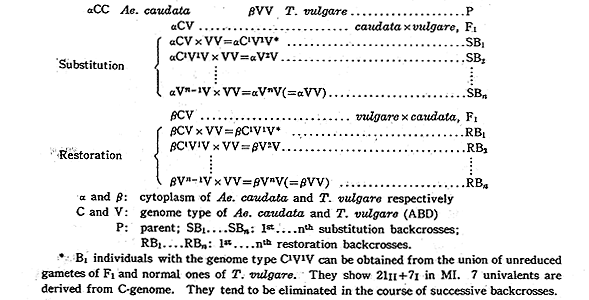
Male sterility: AlphaVV shows complete male sterility. Though 21 paired chromosomes are observed in PMC's and the meiosis proceeds normaly, 2nd mitosis in the pollen grains does not occur and the tapete cells degenerate at early stage.
AlphaVbV, which involves one of the caudata Sat-chromosomes, is fertile to some extent; AlphaVbVb has higher pollen fertility.
Change of genome constitutions: Sometimes some of the AlphaVV and restored BetaVV strains exhibit the characters of Ae. caudata, such as non-waxy stem, and black spike. Pistillody occurred unexpectedly, suggesting certain change of genome constitution. This character is mainly inherited maternally and day length plays an important role in producing pistillody. AlphaVbVb and BetaVbVb bear black spike character, which is assumed to be located on Sat-chromosomes from Ae. caudata.
Wheat-Rye
Triticale types: Triticale types (2n=56) were produced by doubling the chromosomes of F1 hybrids between T. vulgare and S. cereale with the colchicine treatment. According to the performance test, even a strain Tc. No. 17 which was considered to be promising, was found not favorable for the practical cultivation.
Substitution and heteroploid types: (a) Substitution types (2n=42) occurred presumably by the reduction of chromosome number in the progeny of certain Triticale which revealed irregularities in meiosis. In No. 749-14 derived from Triticale No. 749, about 3 pairs of wheat chromosomes are substituted by rye chromosomes, and in No. 88c derived from Triticale No. 54, about 5-6 pairs. In both strains, the character " hairy neck " occurs as in Triticale. This perhaps shows that a gene (or genes) for the character is located in one of the substituted chromosomes.
(b) Substitution types (2n=42) and a heteroploid type (2n=44) were obtained in the progenies of (T. compactum x S. cereale) F1 x T. compactum. They were classified into a number of groups according to the ear types.
In W.R. Nos. 86 (A), 182 (J) and 195 (U), each having 2n=42, at least one pair of wheat chromosomes are substituted by the rye chromosomes. W.R. No. 194 (U) has 44 chromosomes, of which 42 are considered to be mostly homologous to those of wheat, while the remaining two probably involve the rye-chromosome portions. Ryes with wheat cytoplasm were obtained by the successive backcrosses of Triticale with rye pollen. As compared with the normal, their maturity is later and their culms are shorter; the development of seeds and the fertility are normal.