Each species of Triticum and Aegilops has its own specific value of C. Throughout Triticum and Aegilops only two genomes, A and D, have C-values significantly higher than fifty per cent. Namely, genome A shows the highest value of C (80% or more), and D about 65%, whereas C, M, Cu, and Sl give no indication of regularity in spikelets. Emmer (AABB) and T. Timopheevi (AAGG) have C-values of about 50 per cent, which means the absence of the regularity. This suggests that genomes B and G suppress the effect of the genome A. Dinkel wheats (AABBDD) have about the same C-value as Ae. squarrosa (DD), indicating the dominancy of the D genome over AABB.
Polygenic analysis: In 1951, a crossing experiment was carried out between two species of Einkorn wheats, T. monococcum flavescens (C=78.2%) and T. aegilopoides boeoticum (C=88.2%). In 1954, besides the two parental species, F1, F2, F3 and backcrossed generations (B1, B2) and back-cross selfed generations (B1s, B2s) were analyzed; their C-values were as follows: F1=93.1, F2=87.2, F3=84.9, Bi=86.7, B2=90.5, B1s=82.9 and B2s=89.8 in percent, respectively.
The C-value which satisfied the Mather's criteria (1942) was used to measure the expression or right- and left-handedness in spikelets.
Variation measured can be partitioned into three components. The estimates of the contributions made by nonheritable (E1, E2), fixable heritable (D) and unfixable heritable variations (H) are D=35.4 + or - 17.7, H=46.4 + or - 37.7, E1=36.8 + or - 4.9 and E2=16.2 + or - 4.7 in percent, respectively. Since H is pretty larger than D, it seems that there is a marked degree of dominance, but the high value of its standard error makes this conclusion somewhat unreliable.
The genetic portion in variances in various generations was found to be significant. The heritability of F2-generation was about 44.3%. The large portion of the nonheritable in variances may have been caused both by environmental fluctuations and the experimental systematic errors.
The numbers of effective factors concerning the intensity of the right- and left-handedness were estimated by several methods. The greatest estimate was 2.3 and the smallest 0.6.
Japanese Varieties of Wheat
The wheat, varieties of standard productivity recommended by the government to the farmers are registered by the Norin numbers. Norin is the abbreviation of the Department of Agriculture and Forestry. From 1926 up to the present, 90 Norin varieties have already been established. Through the studies on various hybrid progenies it became clear that high productivity together with early maturing habit and disease resistance can be secured only by crossing of selected parents. Therefore, the parents of the Norin varieties are few in number. For example, Norin winter wheats for the snowy parts of Japan have been raised as follows:
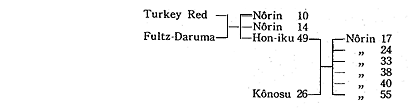
Norin 3 which was registered in 1930 is a selection from the hybrid progeny of Triticum vulgare x T. durum. In 1939, this variety covered about 10,000 acres.
The Japanese indigenous wheats are characterized by the short stature, early maturation, short and flat ear, mealy and red grain.