2. Development of short secondary hexaploid
Triticales by crossing Triticale with
wheat
Amphiploids coming from crossing primary tetraploid wheat
with rye are more difficult to develop than octoploid
Triticales. Even if we succeed in turning the sterile
hybrids amphiploid, the amphiploids thus obtained have poor
fertility, very shrunken, shrivelled grain type and no
variability at all, which is one of the most important
phenomena in nature. It is highly improbable than in
practical growing such primary hybrids will successfully
compete with the classical cereals developed thousands of
years ago (wheat, barley, rye and oats). Such primary
hybrids have not developed yet. The Canadian and Hungarian
Triticales now available are progenies of complex
crosses.
At first PISSAREV and ZSILKlNA (1967), SANCHEZ-MONGE (1958),
MOGILEVA (1969) and we ourselves as well, wanted to develop
wheat forms with the quality characteristics of rye, with
higher protein content, earlier maturity and stronger straw
from crosses, between Triticale and wheat. Only from
1962 onwards have we tried to select in the direction of
Triticale and no more in the direction of wheat.
Triticale and wheat crosses have been especially used
for developing short Triticales. In the first years
the following short wheat varieties were used as parents:
Norin 50, Norin 16, Freccia, Ardito, San Pastore, Mara,
Produttore 6, Produttore 13. Besostaja 4, 1, Shkorospelka
3b. Etoile de Choissy, Magdalena. Heine VII, etc.
These wheat varieties did not succeed in dwarfing rye and
Triticale varieties. The F1 hybrids
obtained were in every case as high as the higher parent,
and even if in advanced generations we did succeed in
developing shorter hybrids they were practically without any
value.
In 1965 we crossed our Triticale varieties No. 57 and
No. 64 with the dwarf wheat variety Ble Tom Pouce, received
from our colleague LEHMAN in Gatersleben. We heard later
that this wheat variety was brought to Europe and America by
the Hindukush expedition. This was the first wheat in which
dwarfness inherited dominantly. Dominance means that its
hybrids with 130-180 cm tall rye and Triticale were
60-70 cm tall in the first year, thus very close to the
height of the wheat Tom Pouce, which is 40 cm tall. The
F1 hybrid was twice, maximum three times,
backcrossed with hexaploid Triticale; in the
segregating progeny generations Triticales were
selected from 20 cm up to 180 cm. Types higher than 110 cm
were used to complete our collection. The short, constant
types were divided into 4 groups:
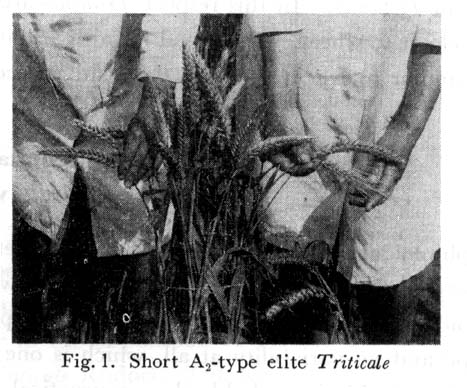
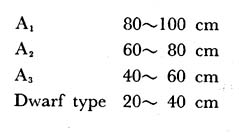
Most of the short types had strong straw and good grain type
were winterhard and some lines were extraordinary fertile.
The dwarf type alone has poor fertility. Cultural methods of
today are, however, not yet suitable for growing dwarf
plants, even if they were fertile.
It is mainly from wheat and not from rye that variability
with special regard to dwarfness - can be introduced to
Triticale. When selecting we have only to take care
of fixing ear productivity inherited from rye in the
advanced generations, too.
Literature Cited
KISS A. 1970. Spontaneous crossing between hexaploid
Triticale Rosner and Triticale No.64. W.I.S.
31: 24-25.
KROLOW K. D. 1969. Cytologische Untersuchungen an Kreuzungen
Zwichen 8x und 6x Triticale II. Untersuchungen an
F2. (Meiosis), F3- und F4-
Pflanzen. Zeitschr. f. Pzg. Bd. 62(4): 311-342.
MOGILEVA, V. I. 1968. Iszpol'zovanije amfidiploidov
Triticum Triticale v szelekcii sz povusennum
szoderzsaniem belka. Domoradice 1-17.
PISSAREV, V. E.-ZSILKINA, M. D. 1967. Triticale
(2n=42). Genetika, MOSZKVA 4: 3-12.
SANCHEZ-MONGE, E. 1958. Hexaploid Triticale. First
Intern. Wheat Genet. Symp., Manitoba, 181-194.
(Received July 4, 1970)