Examples: I, II, IV ; Z
XIV. When there is a positive evidence of polyploidy, the same symbols are repeated as many times as there are alleles.
Examples: +++ ; ++a ; aaaa
Trisomic and tetrasomic chromosomes are represented similarly as in triploids and tetraploids respectively.
XV. The linkage of genes is shown by symbols written in the order of the loci with a horizontal line above the symbols.
Example:

XVI. Gene formulae are usually written in a duplex system.
Example: A+Abbc+cDD
When the gametic gene formulae of the parents are known, they are shown by inserting a period between them.
Example: Ab+cD +AbcD
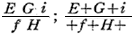
XVII. For two or more genes belonging to the same linkage group of known loci, symbols in the form of fraction are used with the female gametic formula as the numerator, and the male gametic formula as the denominator, without any line above the symbols.
Examples: E+G+i/+f+H+ ;
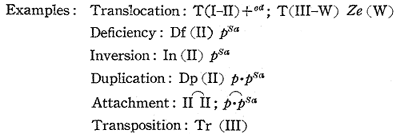
XVIII. A chromosomal aberration is represented by the abbreviation of the type of the aberration, with chromosome numbers in parenthesis, followed by symbols of the participating genes.
XIX. So far as there is no serious inconvenience, the law of priority should be observed for the first published symbols.
XX. Italic type is used for genes, Roman small type for chromosomes and Roman capital type for genomes. (Additions under XX by Kihara).