Hitoshi Okamoto, Yoshihiro Yoshihara, Fumi Kubo
Center for Brain Science, The Institute for Physical and Chemical Research (RIKEN)The genome sequences of many species of animals, including human, are being revealed, and it is now becoming possible to roughly speculate the gene-coding regions. However, to elucidate the functions of each gene product in the complicated biological process, it is an urgent subject to develop the system in which the functions of genes identified from the genome sequences are rapidly analyzed. Although a majority of the vertebrate genes are considered to be expressed in the brain, the functions of most of these genes remain unclear. To systematically identify genes that are involved in the process in which the neuronal cells in the brain differentiate to form neuronal networks, we performed a large-scale screen for mutations that affect the formation of neuronal networks, especially that of motor neurons. In this project, we establish the mutant strains obtained in the screen, which will be useful for the future study in the neural developmental biology.
It is an urgent subject to develop the system.
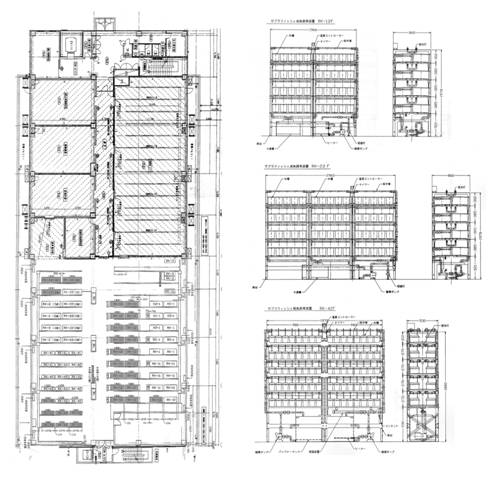
We set up an aquatic animal research facility on the second floor of the BSI Ikenohata Research building, which was newly constructed in RIKEN. The layout of the facility is depicted in Figure 1. Using the budget for 2003, we set the fish systems shown in gray in Figure 1, and prepared for moving the fish from the old facility. We moved the experimental hardware from the old facility to the new facility in June 2004. After the test-run of the fish systems, we began to move the fish in August, and we finished moving by October 2004. This facility will be used for Bio Resource Project, and furthermore it will be open to visitors so that they can learn zebrafish experimental systems.
Figure 1A. The aquatic animal research facility (left) and the fish systems (right).
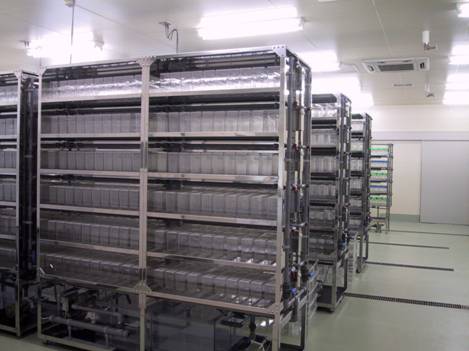
Figure 1B. Zebrafish Room.
Fish room for wild-type, mutant, and transgenic zebrafish. It has a capacity for approximately 10.000 fish tanks, including 1 liter, 5 liter, and 7 liter tanks. It is also equipped with micro-injection devices for gene transfer experiments, microscopes, etc.
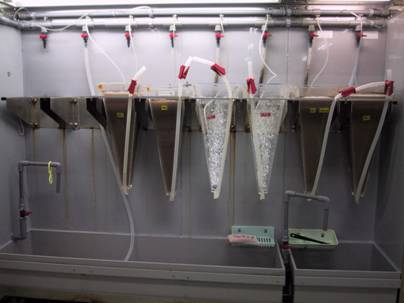
Systems for baby fish breeding 1

Systems for baby fish breeding 2
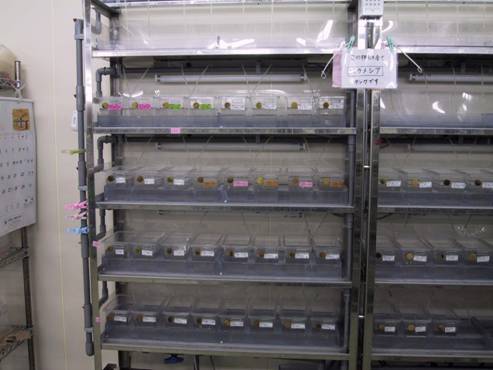
Systems for adult fish breeding 1

Systems for adult fish breeding 2
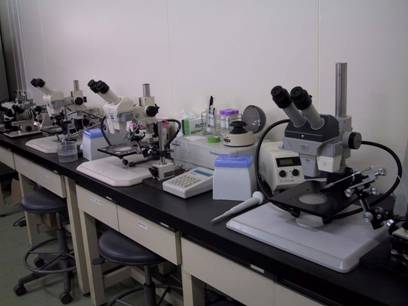
Microscopes for embryo manipulation
Systems for brine shrimp breeding
Bottles for paramecia breeding
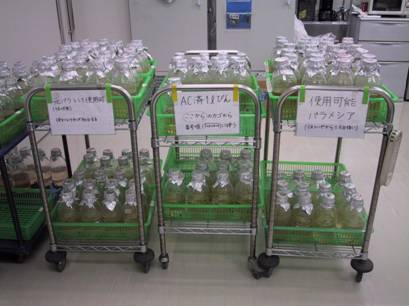
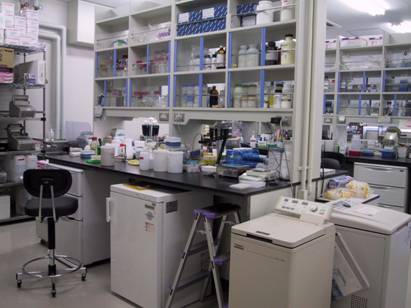
Figure 1C. Bio Resource Project Room
This room is equipped with PCR machines, centrifuges, electrophoresis systems, etc, which can be used by the visitors for various experiments.
Okamoto’s and Masai’s groups in the core facility, in cooperation with JST, have screened for mutants using transgenic fish that express GFP specifically in the motor neurons. By screening 1,817 mutagenized genomes using 1,171 F2 families during 2003-2005, we identified 715 mutants that have defects specifically in the neuronal differentiation or the development of the specific body structures. Of these, we selected 171 mutants that have specific phenotypes and are worth analyzing at the gene level. We made a database for these mutant strains. After analyzing these mutants in detail, we will publish papers and distribute the mutant strains to public. Before that, the mutants may be distributed to the researchers for purposes of collaboration.
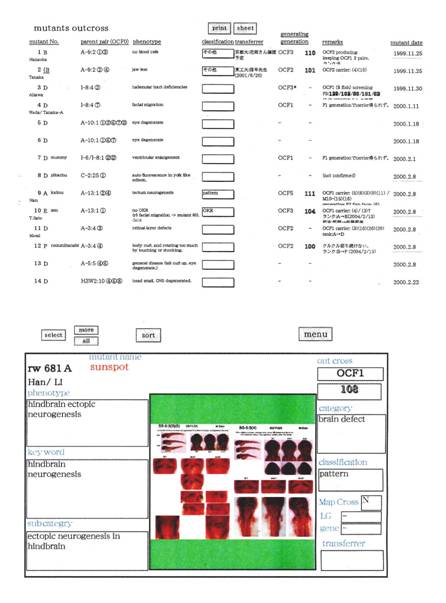
Figure 2. Example pages of the list of the mutants obtained in the screening by Okamoto’s and Masai’s groups (upper panel) and the database of the mutants (lower panel).
Okamoto’s group has tried to determine how comprehensively it is possible to identify genes that are important for each key point of the brain neuronal cell differentiation, by systematically screening for mutations affecting the motor, sensory, and lateral line neurons in zebrafish. By 2003 we have identified the mutants that have defects in the differentiation and axon extension of motor, sensory, and lateral line neurons in the hindbrain and spinal cord. 27 mutations affecting Isl1-GFP transgene expression patterns, 45 mutations affecting axon extension visualized by antibody staining, and 2 mutations affecting behavior were identified.
In our experiences, phenotypes of the mutants that have defects in the axon extension tend to be affected by genetic background, and such phenotypes are occasionally disappeared by outcrossing or mapping crossing. Therefore, we have to repeat crossing to establish phenotypically stable mutant lines. So far, we have established or now trying to establish the following 33 mutant strains, in which the phenotypes are highly stable and specific and furthermore we can easily speculate what cells and in what ways are affected.
Mutants that have defects in the differentiation and axon extension of the trigeminal and facial motor neurons.
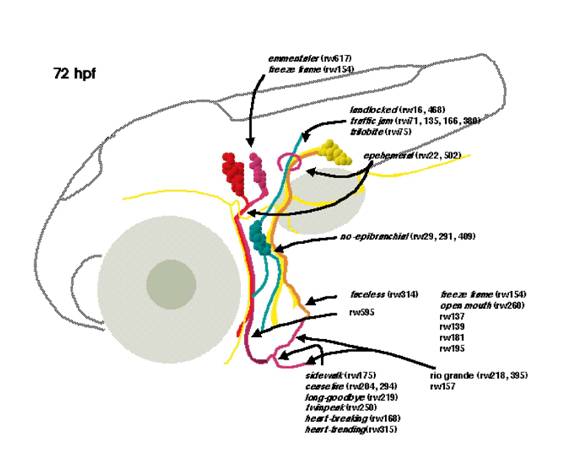
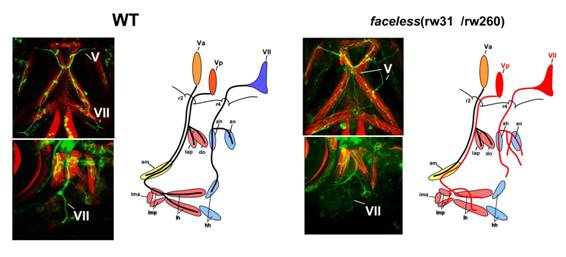
F. Mutant that has specific defects in the axon extension of spinal motor neurons.
As a result of the mutant screen mentioned above, we obtained 27 mutants exhibiting aberrant layer structure of the retina, 9 mutants exhibiting aberrant lens, 3 mutants exhibiting degeneration of photoreceptors, and 6 mutants exhibiting aberrant eye morphology. Masai’s group collects and preserves these mutants and furthermore analyzes the following mutants supported by the grants other than this project.
I. Mutant that exhibits excessive proliferation of the retinal progenitors: ascending and descending (add)
J. Mutant that exhibits cell death in retinal neurons: pinball eye (piy)
K. Mutants that exhibit degeneration of photoreceptors: twilight (tli), eclipse (els), corona (coa)
L. Mutant that has defects in the optic cup development: detached (det)
The mutant screen by Okamoto’s and Masai’s groups has identified 16 mutations affecting the ear development (3 mutants exhibiting no otic vesicles, 4 mutants exhibiting no semicircular canals, 6 mutants exhibiting aberrant otolith development, and 3 mutants exhibiting enlarged otic vesicles). These mutants will be studied by Funahashi’s group in Tohoku University. Lateral line mutants will be studied by Shoji’s group in Tohoku University. In addition, groups in Saitama University (Masataka Nikaido), University of Tokyo (Atsushi Kawakami), Tokyo Institute of Technology (Yoshiyuki Imai, Akira Kudo), Kyoto University (Atsuo Kawahara), and Nagoya University (Yutaka Kikuchi) are interested in studying the mutants identified by the Okamoto’s and Masai’s groups, and we decided to provide the mutants to these groups during 2004.
We made a database for transgenic fish strains established in Okamoto’s and Masai’s groups, using the allele nomenclature shown below.
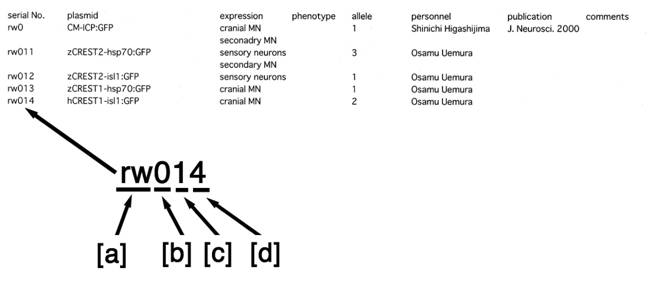
a : RIKEN Wako campus-specific designation
b: 0 indicates that the strain is transgenic
c: laboratory numbers in RIKEN Wako campus
1: Okamoto’s group, 2: Masai’s group, 3: Yoshihara’s group
d: successive numbers for transgenic fish used within the laboratory

We distributed fish strains to the following organizations as test cases. Since the MTA form for Bio Resource Project was not ready, we used the MTA form issued by BSI, RIKEN.
In 2003, we concentrated to set up the fish breeding systems in the core-facility, to construct the system to maintain the mutant strains obtained in the core-facility, and to make a database for the fish strains. In 2004, using the knowhow we got so far, we will make a database of the fish strains, including those preserved in the sub-facilities, and we will decide how the information of these fish strains is disclosed to the community. Studies using zebrafish are rapidly progressing and highly competitive. Therefore we have to consider to what extent we disclose the information and to what extent we keep it confidential.
