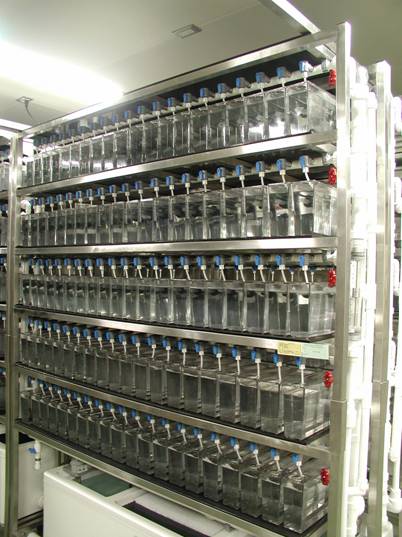
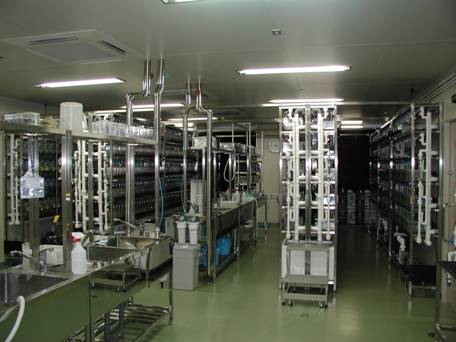
In mid-1990's Dr. Driever's and Dr. Nusslein-Volhard's laboratories reported success of large-scale mutant screen in zebrafish. After that zebrafish has been used in many laboratories as a model vertebrate amenable to genetics, and various mutations have been isolated. However, most of these mutations have been created by the chemical mutagen ENU, which generally induces point mutations. Therefore, to identify mutant genes we had to perform positional-cloning, which requires an enormous labor. In contrast, in other model organisms, such as Drosophila and mouse, powerful methodologies for forward genetics, for example enhancer-trap and gene-trap, have been developed. Using these methodologies, genes that play important roles in morphogenesis and organogenesis of animals have been discovered and their functions have been studied. In zebrafish such methodologies have not been developed for a long time, because the useful tools, such as transposon P-element in Drosophila and ES cells in mouse, have been absent. Under such circumstances, zebrafish researches have longed for the genetic methodologies such as gene-trap and enhancer-trap.
To develop enhancer-trap method, we had to establish the way to integrate the reporter gene to zebrafish genome efficiently and randomly. Unfortunately, there were no efficient transposon systems in zebrafish, such as Drosophila P-element. The transposable element Tol2 that has been found in the medaka genome became a subject of our attention. Tol2 is a repetitive sequence found in the medaka genome, has similarity to the maize Ac element, and belongs to the hAT family of transposons. We first found that the Tol2 element has a gene composed of 4 exons. Next, we revealed that this gene encodes an active transposase that catalyzes the transposition reaction. Furthermore, we succeeded to integrate the Tol2 transposon vector carrying foreign genes into the zebrafish genome very efficiently, by using the transposase activity. Through these studies, we established a highly efficient system to generate transgenic zebrafish.
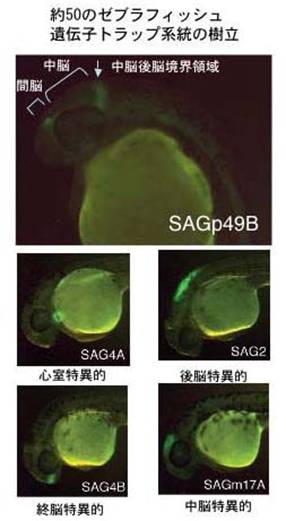
By using this efficient transposition system, we started to develop the gene-trap method in zebrafish.?A splice acceptor site, the GFP-coding sequence, and a polyA signal sequence were inserted into the Tol2 transposon vector. This GFP gene in the gene-trap vector is not expressed per se, because it has no promoter sequence required for the activation of transcription. Using this transposition system, we have generated more than 500 zebrafish lines randomly inserted with the gene-trap vector. We cross these zebrafish lines carrying the gene-trap vector, and we observe their progeny embryos. When the gene-trap vector traps a gene in the genome, the reporter gene GFP is expressed mimicking the expression pattern of the trapped gene (Figure 1). Transparency of embryos, one of the most useful features of zebrafish as a model organism, enables us to observe developmental stage-specific, cell type-specific, and organ-specific expression of GFP in the live embryos under a low-magnification fluorescence microscope. Of the 500 zebrafish lines inserted with the gene-trap vector, about 50 lines expressed GFP in specific patterns (Figure 2). Thus, by using the Tol2 transposon system, we succeed to develop the efficient gene-trap method in zebrafish for the first time in the world.
Figure1
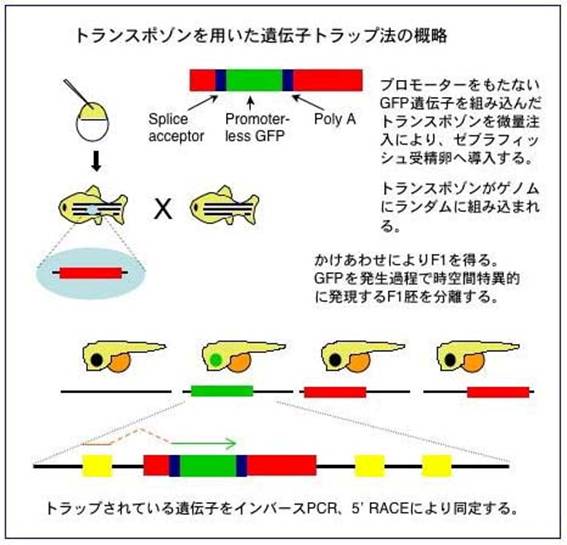
Figure 2
In the mouse gene-trap method, the retroviruses carrying the reporter gene without promoter are infected to ES cells. When the retrovirus is inserted to the expressed gene, the reporter gene, such as the neomycin-resistant gene, is expressed and the ES cells form a colony resistant to the drug. After pre-screening these ES cells, those carrying interesting insertions are transferred to female mice to produce offspring, whose phenotypes are then examined. Zebrafish has an advantage over mouse, because we can pre-screen to find the interest integrations by examining the reporter gene expression in live individuals. Taking advantage of this merit, we will improve the gene-trap vector and will perform a large scale gene-trap screen. In National Bio Resource Project, we maintain the useful gene-trap lines and establish the system to provide the fish lines to researchers.
 Collection: zebrafish enhancer-trap lines and gene-trap lines