K. YAMASHITA
Biological Laboratory, Kyoto University, Kyoto, Japan
With a Rockefeller research grant, the Kyoto University, Kyoto, Japan, organized the Botanical Mission to the Eastern Mediterranean Countries, including Egypt (U.A.R.), Lebanon, Syria (U.A.R.), Jordan, Turkey, Greece and Italy, for the collection of mainly wheat and Aegilops materials for the studies on the origin of wheats.
Members
Dr. Kosuke Yamashita, Professor of Biology, Kyoto University (Leader)
Mr. Masatake Tanaka, Assistant Professor of Genetics, Kyoto University
Dr. Osamu Suzuka, Lecturer of Cytogenetics, Kyoto University
Mr. Seiji Nakamura, a cameraman of the Nichiei Co. Ltd., Tokyo
Proposed Project
A proposed project is referred to WIS No. 8, as follows:
"According to the cytological and genetical studies of Dr. H. Kihara, the former Professor of Genetics, Kyoto University, Japan, it is known that the genealogical relationship of wheats and their relatives is as follows:
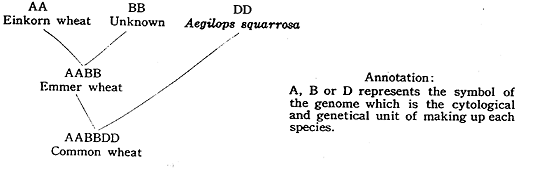
DD-species has already been found to be Aegilops squarrosa, a wild growing species from Pakistan to Iran through Afghanistan, and it is thought that our common wheat, AABBDD, occurred by the hybridization between Emmer wheat and Aegilops squarrosa in those regions.
Similarly, it is presumed that Emmer wheat was originated by the crossing between Einkorn wheat, an existing diploid wheat species, and a certain unknown species with BB constitution. By recent studies, however, it is thought that BB-species can be the species of the Section Sitopsis of the genus Aegilops. It is also known that the species of Aegilops are distributed in the Eastern Mediterranean Countries.