M. S. CHENNAVEERAIAH
Institute Botanique, 4101 E. Sherbrooke, Montreal, Canada
and P. SARKAR
Indian Agricultural Research Institute, New Delhi, India
This monotypic taxon occupying an isolated position in the tribe Hordeeae is an annual, and grows on rocky and dry slopes of foothills in semi-arid zones of Caucasus and Central Asia. The general distribution is from the Eastern Mediterranean, Armenia-Kurdistan to Iran. In the manner of disarticulation of spikelets Heteranthelium remotely resembles the genus Eremopyrum; in the structure of awns it resembles Aegilops; and in the structure of glumes, the genus Hordeum. Seed and spikelets of it for our study were obtained from "Hortus Botanicus," Taschkent, U.S.S.R.
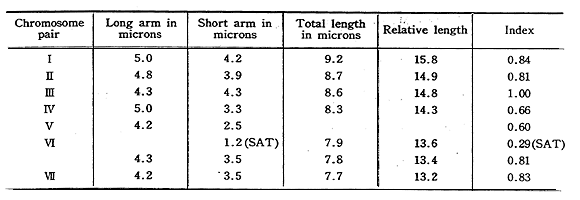
The somatic chromosome number counted from the root tips is 14. Its karyotype has all chromosomes with median or submedian centromeres and one pair with satellites. The chromosomes have been measured: the lengths of long and short arms of each pair in microns, relative length of each pair (expressed as a percentage of the total sum of the lengths of all chromosomes in a plate), and the index (ratio of short arm to long arm) are given in the following table.
In view of the recent interest in the transfer of various characters to wheat from related wild species, by using monosomic and nullisomic lines, this little known species should be more intensively studied and its relation with the other species of Hordeeae clarified.