F. C. ELLIOTT
Farm Crops Department, Michigan State University East Lansing, Michigan, U.S.A.
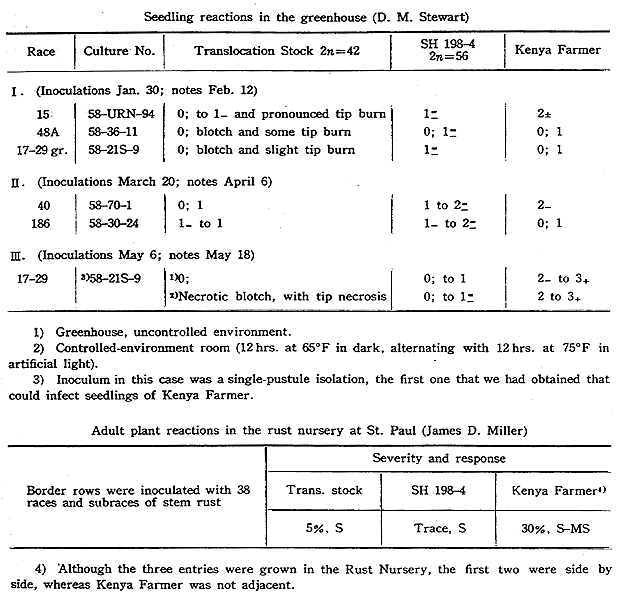
Recently the author reported the translocation of stem rust resistance from an Agropyron elongatum-common wheat derivative (SH 198-4, 2n=56) to a stable hexaploid wheat referred to as a translocation stock (J. Hered. 48: 77-81, 1957). During the past year critical information relative to the rust reactions of the translocation stock, the resistant octaploid parent, and Kenya Farmer has been obtained by the Cooperative Rust Laboratory, University of Minnesota, St. Paul. A summary of this information has been generously made available for inclusion in the WIS Bulletin and is appended to this report.
A slight difference in reaction to Race 15 (Culture No. 58-URN-94) is evident between the translocation stock and the octaploid parent on one hand and Kenya Farmer, although this is not considered significant. When the single-pustule isolate of the 17-29 group was used, however, (Section III, footnote 3) there was a difference between the reactions of Kenya Farmer and the other two selections. Thus, the stem rust resistance of the translocation stock and Kenya Farmer are not identical genetically. Though differing by 14 chromosomes the parallel reactions exhibited by the translocation stock and its parent to the biotypes involved indicate that a major component of resistance was transferred to the hexaploid. This line is quite unique in that the rust reaction of the resistant parent is combined with other characters not found in either parent such as red glumes and red seed coat color. During the past year Swaminathan and Natarajan (J. Hered. 50: 177-187, 1959) have reported the induction of some very interesting and similar mutants by vegetable oils. From the variety C. 591 with white glumes and amber colored grains they obtained a wide array of mutants including those with red seeds and others with red glumes.
An attempt will be made to relate the glume and grain color of the translocation stock to other natural and induced types of a similar nature.