K. MATSUMOTO
Biological Laboratory, Osaka University of Liberal Arts and Education Osaka, Japan
If an allopolyploid plant, AABB, and one of its ancesters, AA, are known, the following formulae will be applied for estimating the number of awns of the other ancester, BB. The relation of dominancy in regard to the number of awns is:-awnless<single awned<many awned, as established by Kihara and Matsumoto(1939) and Kihara(1954).
When AA>AABB, then BB falls in between 0-(2AB-AA). . . . . (1)
When AA=AABB, then BB falls in between 0-AA. . . . . . . . . . (2)
When AA<AABB, then BB falls in between AB-(2AB-AA). . . . (3)
The number of awns of empty glume of apical spiklet is 5 in Ae. ovata (CuMo) and is 3 in umbellulata (Cu). Applying these numerals to the formula (3), then Mo falls in between M 5-7. This indicates that the MoMo plant, if exists, would possess 5-7 awns on each empty glume of apical spiklet.
Similarly the number of awns in hexaploid triaristala will be calculated, as follows: the number of awns of (CuMtMt2) is 3 and that of tetraploid triaristata (CuMt) is also 3, therefore Mt2 falls in between 0-3. This indicates that Mt2 plant, if exists, would have 0-3 awns. Thus calculated numbers of awns of empty glumes and outer glumes in apical spiklet are tabulated in the following table.
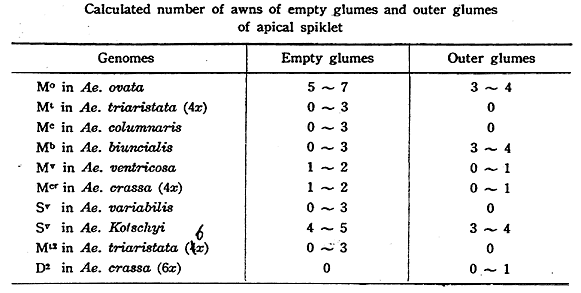
According to the Eig's principle on evolution, the more awned is more differentiated. Hence, I should draw the following conclusions regarding the number of awns.
1. The modified genome Mo, involved in Ae. ovata and Sv in Kotschyi, is most differentiated.
2. The two genomes involved in the hexaploids, namely D2 and Mt2, represent little or no differentiation.
3. The modified genomes in M group involved subordinately in tetraploid species are more differentiated than those in diploid species.
The results obtained from the investigations on the following characters of the ear also support the present conclusions:
1. Number of awns and teeth of empty glumes in apical spiklet.
2. Number of awns and teeth of empty glumcs in laterai spiklet.
3. Number of awns of outer glumes in apical and lateral spiklets.
4. Color and hairs of glumes.
5. Keel of glumes.
6. Disarticulation of ear.