(go to
KOMUGI Home) (go
to WIS List) (go to NO.78
Contents)
Preservation of
Barley Genetic Stocks in Okayama University
Shozo Yasuda
Okayama Women's College
Ariki 787, Kurashiki 710, Japan
Cultivated barley ranks fourth in world cereal production. Barley is
also known to be the most progressing crop for gene analysis after
maize and tomato. Many morphological and physiological characters of
barley are rather easy to distinguish, and are governed by major gene
or genes. Sogaard et al. (1982), as a master list of barley genes,
have cited more than 900 genes including about 400 genes of which are
evident in their related chromosomes. These traits will prove the
usefulness of barley as an experimental organism for genetics,
mutation, molecular biology and so on.
I will here introduce outlines of the Barley Germplasm Center of
Research Institute for Bioresources, Okayama University, which was
established in 1979. About 4,000 barley varieties collected from
around the world by Dr. R. Takahashi, Emeritus Prof. of Okayama
University, were preserved as the base of the collection. The
contents of the collection at present and the activities of the
Center are as follows:
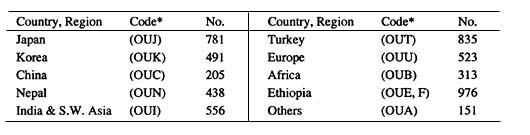
1. Cultivars (ca. 5,300: *Okayama University accession code)
2. Wild species (OUH): 274 strains of 25 species, including H.
spontaneum, H. bulbosum, H. murinum and so on.
3. Mutants (OUM): 421 spontaneous and induced mutants.
4. Linkage testers (OUL): 172 lines including those from barley
geneticists overseas and from the genetic analyses made at the
Institute. Two sets of trisomic lines (H. spont. transcaspicum
and Shin Ebisu 16) which were identified by Dr. T. Tsuchiya.
<--Back | -->Next
(go to
KOMUGI Home) (go
to WIS List) (go to NO.78
Contents)