High temperature is a major abiotic stress which severely damages wheat in WANA. Its effect is compounded in the presence of moisture stress after anthesis. It was, therefore, felt necessary to study and answer three questions, i.e., a) Is there enough genetic variability for this trait in wheat germplasm of WANA; b) which species (bread or durum wheat) is more tolerant, and; c) is ICARDA/CIMMYT narrowing down genetic variability in wheat germplasm? Heat tolerance was studied on the basis of thermostability of the cell membrane which was estimated as the percent membrane injury (electrolyte leakage) (Blum and Ebercon 1981; Saadalla et al. 1990; Shanahan et al. 1990; Tahir and Singh 1993).
The heat tolerance of 241 bread wheat, 103 durum wheat lines/varieties, originating from WANA (Table 2) was studied died along with a heat resistant check, Tam 107, and a susceptible check Nugains.
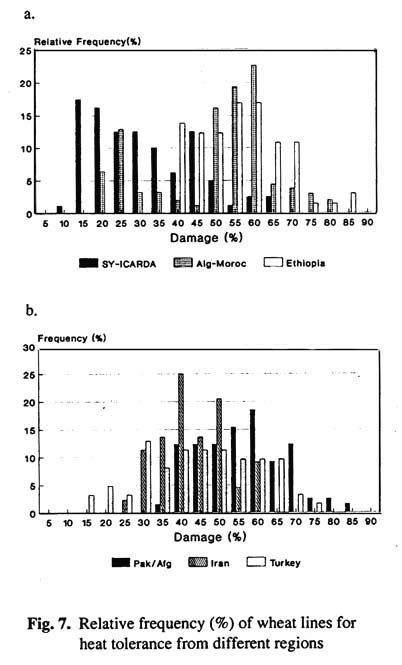
Data on the heat tolerance of 344 wheat lines/varieties are presented in Fig. 6. Percentage injury was classified into four groups: 1) 0-20% injury = resistant; 2) 21-40% injury = moderately resistant; 3) 41-60% injury = moderately susceptible and 4) more than 60% injury as susceptible. Eighteen percent of the lines were highly resistant to heat and better than the resistant check Tam 107 (25% injury). A fairly large number (53%) of the lines were found to be moderately resistant to heat. Heat tolerance data in Fig. 6 shows that on an over all basis ICARDA developed material had the lowest heat damage followed by Iran and Ethiopia. However, the mean heat damage (%) does not give true picture of the total genetic diversity for each country. The data presented in Fig.7 a & b of each country revealed that Turkish wheat germplasm was the most diverse in which damage (%) ranged from 15 to 75%, whereas out of Iranian germplasm the minimum damage observed was 25%. 'Me frequency distribution of heat tolerant lines shows that ICARDA generated material contained the most tolerant lines followed by Turkey, Algeria/Morocco and Iran, whereas Ethiopian, Pakistani/Afghanistan material was more susceptible to high temperature. The heat tolerant lines of these countries, in most of the cases, originated from heat prone areas, indicating that the possibility of identifying suitable sources of resistance to high temperature are higher where the problem of heat stress to the crop is severe. The ICARDA/CIMMYT lines were derived from selection under high temperature conditions. A great majority of the material developed at ICARDA is, therefore, much more heat resistant than the local germplasm from WANA.
Though cumulative frequency distribution data on heat tolerance shows that bread wheats are more heat tolerant but statistically no significant difference between Triticum aestivum and T. durum lines was observed (Fig. 8). Heat tolerance seems to be more related to the ecological origin and to selection pressure for high temperature tolerance. Therefore, we suggest that early breeding generations should be subjected to high temperature under field conditions, and field selected material should be rated on the basis of percent membrane injury to isolate any non-resistant lines or lines possessing avoidance mechanisms.
These studies indicate that ICARDA/CIMMYT is not reducing or narrowing down the genetic variability for the above mentioned traits. However, the narrowing down of genetic diversity can be seen in terms of lower frequency of material on the susceptible side and more on resistant side. But this kind of total diversity if narrowed down is a desirable development.