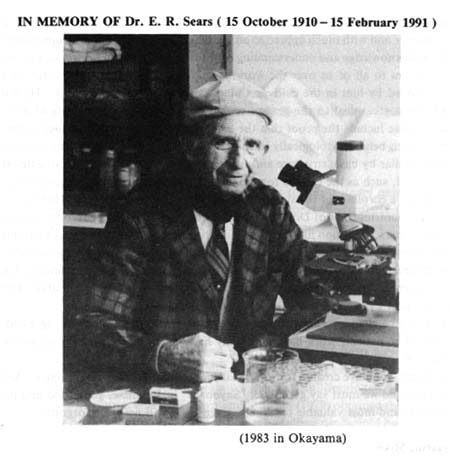
I sincerely wish to
express my heartfelt condolences over the passing of Dr. E. R.
Sears.
I remember clearly when Dr. Sears came to visit Japan on the occasion
of the International Genetics Symposium held in Tokyo and Kyoto in
1956. I went to Haneda (Tokyo) Airport to meet Dr. Sears. He was
already well-known by wheat geneticists in Japan. This was caused
primarily by the fact that Dr. Sears in the U. S. A. and Dr. Kihara
in Japan at about the same time independently discovered during the
Second World War that the D genome of hexaploid wheat had been
derived from Aegilops squarrosa.
During the years when I was a Ph. D. student with Dr. Sears, majoring
in genetics at the University of Missouri, I had many good
opportunities to discuss with him various problems of wheat
cytogenetics almost every day of the week; these discussions
sometimes lasted until midnight by continuing them in Dr. Sears'
home. "McFadden and I" -- Dr. Sears started to say about the origin
of hexaploid wheat many times. I found his deep appreciation of
cytogenetics, not just on wheat cytogenetics, very impressive. He had
a rare warmth of personality. He was the kindest and most generous of
men. Also, he was a scholar of great eminence, indeed. During our
discussions, he talked always with a good sense of humor and with
much appreciation for the achievement of his Japanese colleagues.
His wide knowledge and understanding of wheat-are revealed in his
work. Certainly the most important to all of us over the world,
working with wheat, is the wheat aneuploid series developed by him in
the cultivar Chinese Spring of common Wheat. He has contributed also
a great deal to the general understanding of the cytogenetics of
wheat and relatives. These include the proof that the loci are
duplicated on the homoeologous chromosomes which behave cytologically
as though they would be non-homologous but genetically very similar
by basic structure and function. There are genes with a drastic
effect in duplicated loci, such as the Q gene for the origin
of the squareheaded, non-spelting naked wheat. It was a corollary of
the studies that the Ph gene was discovered. There were many
other unique contributions of Dr. Sears, such as the nulli-tetra
compensation combination, the chromosome substitution lines, telo-
and isochromosomes, introduction of chromosome segments from foreign
genomes, etc. He developed most of stocks with a pair of forceps and
made great contributions to the many fields of modern genetics and
agricultural sciences. There is no doubt that these are the fruits of
Dr. Sears' assiduous labor. For these unique devotion I pay my
sincere respect to Dr. Sears.
Once I had a chance to ask Dr. Sears for a few words as a motto. He
suggested to me "patience, to be patient, work hard and study hard".
He meant these as requisites for a cytogeneticist.
Dr. Sears, you have created for us a great jewel to use in plant
cytogenetics. Although you are gone and we must say good-bye,
"Sayonara" in Japanese, your good and precious contributions and most
valuable teachings, given to us will never be forgotten.
Muramatsu, Mikio
Faculty of Agriculture, Laboratory of Plant Cytogenetics and
Chromosome Engineering Okayama University, Okayama, Japan