Genetic effect of ionizing radiation in Einkorn wheat
Seiji MATSUMURA and Taro FUJII
National Institute of Genetics, Misima, Japan
Dormant seeds of Triticum monococcum var. flavescens were exposed
to X-rays, gamma-rays and fast neutrons.
X-rays of different wave lengths at the same dosage (10kr), and
intensity (82 r/min) were used with different filters; also the
effect of gamma-radiation by Co60 was examined for comparison.
The thickness of the filter was adjusted inverse proportion to the wave
length; that is, at 100 KVP a filter of 2 mm Al, and at 180 KVP one of
0.8mm Cu+ 1.5mm Al was inserted into MATSUDA's Type KXC-17 apparatus.
At 50 KVP and 20 KVP, irradiation was applied by two other types, Modified
Type KR-75 and Type TX-20 (Grenz-rays) without filter, respectively. The
data are shown in the following table.
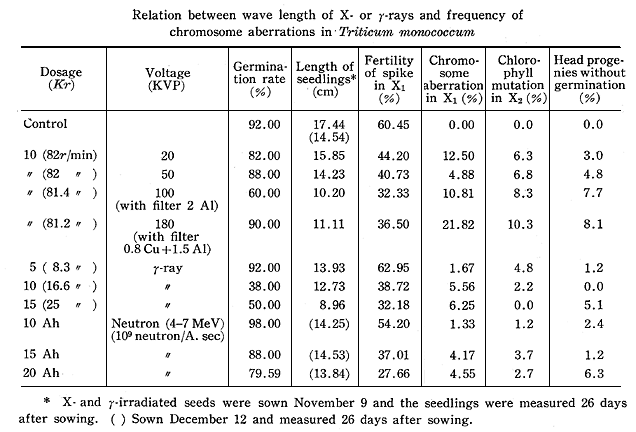
There was no striking difference between hard and soft X-radiation, in
so far as the germination of seeds is concerned, but the growth of seedlings
showed a slight delay with the decrease of wave length. The higher the
dosage of gamma-rays or neutrons, the lower was the germination rate of
irradiated seeds, and the more delayed were the germination of seeds and
growth of seedlings. It was shown, in terms of growth inhibition of the
seedlings, that neutrons with a high specific ionization more uniformly
affect the irradiated seeds than X- and gamma-radiations with a low specific
ionization.
The mean single-spike fertility of X-rayed plants generally decreased
with the decrease of wave length. This relation is in good accord with
that between the growth of seedlings and wave length. Also, the relation
between the rate of induced sterility and wave length coincides roughly
with the relation between the frequency of chromosome aberrations or chlorophyll
mutations and wave length. But at 20 KVP the aberration frequency was
unexpectedly high, while at 50 KVP it was too low.
It was also ascertained,
as expected, that mean fertility decreased with decreasing germination
rate accompanied by weaker growth of seedlings, and the chromosome aberrations
increased in proportion to the dosage of gamma-rays and neutrons. Concerning
the frequency of gene mutations in X2, the head progenies which
did not germinate at all, must be added to the chlorophyll mutations.
(Received May 20, 1958)