Fertility restoration of cytoplasmic male-sterile
Emmer wheats
H. FUKASAWA
Biological Institute, Faculty of Science, Kobe University, Kobe, Japan
As already reported (Fukasawa, 1955), F1 hybrids between male-sterile
durum and T. dicoccoides var. Kotschyanum produced
about 86% good pollen grains. The hybrid plants were somewhat weak and
late maturing. Since some of them died before heading sufficient investigation
have not been carried out. Thus, male-sterile dicoccum (Khapli)
plants which have earlier maturing were used in the crossing experiment
with dicoccoides var. Kotschyanum. The resulting F1
plants showed vigorous growth habit and high pollen fertility (97%) as
expected.
From the selfing or backcrossing with normal dicoccum (Khapli)
plants, many offsprings, sterile, semifertile and fertile plants, were
obtained. They were divided into five classes according to the degree
of their pollen fertilities as shown in the following table.
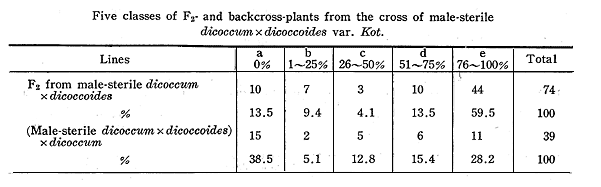
The pollen fertility of semi-fertile plants seems to be influenced considerably
by environmental conditions. From the data obtained, however, it could
be suggested that pollen restoring factor derived from dicoccoides
is not one simple gene, but two more genes are involved.
(Received, May 10, 1958)