Norio KONDO and Masao KAMANOI
Institute for Breeding Research, Tokyo Agricultural University Tokyo, Japan
The partial homology between A and B genomes involved in Emmer wheats was analyzed in their hybrids with colchicine induced 4x Aegilops squarrosa (DDDD) or Ae. bicornis (SbSbSbSb) by Kondo (1941).
The Emmer parents were Triticum dicoccum var. liguliforme; T. pyramidale var. recognitum; T. persicum var. fuliginosum, var. fuliginosum (Black Persian) and var. stramineum; T. polonicum var. vestitum and var. gracile; T. durum var. coerulescens, var. hordeiforme, var Reichenbachii and var. africanum No. 2; T turgidum var. nigrobarbatum; T. orientale; T. dicoccoides var. spontaneo-nigrum and var. Strausianum.
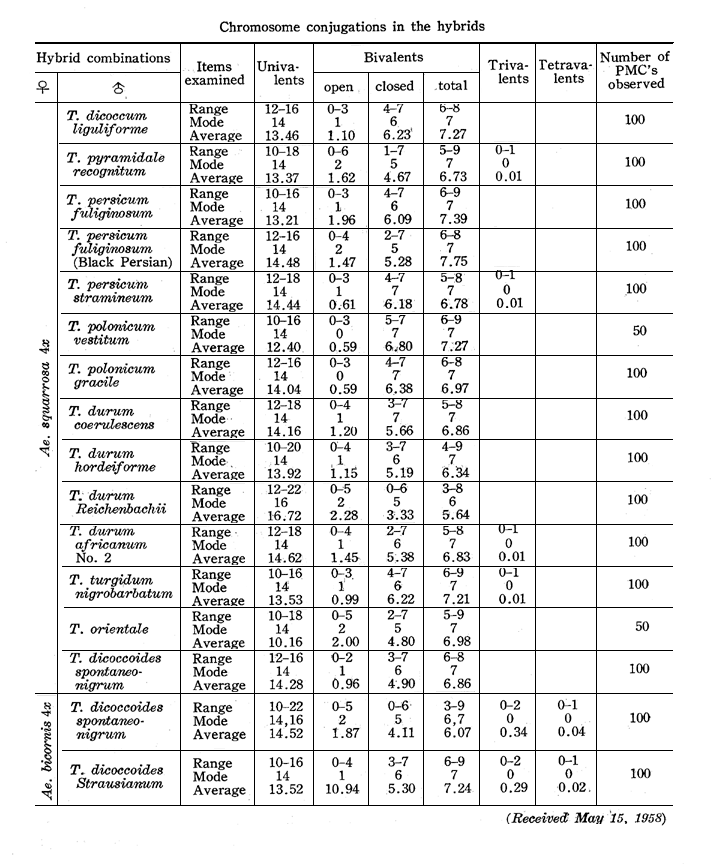
The following table shows the chromosome configurations at MI in those hybrids, which have the genome constitution ABDD or ABSbSb. The number of bivalents observed varied from 3 to 9 (mode at 7). It is expected that 7 pairs of chromosomes might be attributed to the conjugations between D and D or Sb and Sb genomes derived from the pollen parents and additional 0-2 pairs to conjugations due to a partial homology between A and B genomes derived from Emmer wheats, which fairly accords with that Kihara (1936) found 0-3 conjugations in haploid T. durum (AB). However, the conjugations were found to be 3 or 4 in the hybrids.
This indicates that 7 pairs observed could possibly involve certain number of conjugations between A and B genomes of Emmer wheats, according to the varying number of the D-D or Sb-Sb pairings.
Trivalents occurred rarely in the hybrid combinations of 4x Ae. squarrosa, while trivalents and tetravalents were observed in the hybrids of 4x Ae. bicornis, especially with T. dicoccoides var. spontaneo-nigrum indicating that the affinity between A or B and Sb genomes is higher than that between A or B and D genomes.
If B genome were homologous to Sb genome as suggested by Sarker and Stebbins (1956) and Sears (1956), the hybrids between Emmer and 4x Ae. bicornis would have genome constitution related to ABBB. However, the maximum number of trivalents in the hybrids was 2, while that was 5 in the hybrids between Ae. cylindrica and 4x Ae. squarrosa (Kondo 1950) having the similar genome constitution, namely CDDD. On this basis, the present authors can hardly agree with the opinions of Sarkar and Stebbins, and Sears, regarding the riomology between B and Sb.