Effect of gibberellic acid on a compactoid wheat
G. M. WRIGHT
Crop Research Division, Department of Scientific and Industrial
Research, Christchurch, New Zealand
The restoration of normal growth by gibberellic acid in many types of
genetic dwarfing and virus stunting in plants has been reported. It stimulates
growth of wheat and rye, and accelerates internode growth (Lona, 1956);
in rye, no acceleration of flower formation has been found (Lang, 1957).
In a tetrasome compactoid line of wheat, described in a recent communication
to "Nature", the application of gibberellic acid has produced a response
in the early growth of upper internodes, earlier flowering, variable effects
on fertility and possibly a slight reduction in ear density. The results
are not conclusive, as too few plants were available, but they suggest
a need for further work with earlier applications and higher concentrations.
Four plants in the glasshouse at the shot-blade stage (Feekes' scale,
8-9) were treated on September 11, 1957, with 5 or 10 micro gm of gibberellic
acid per plant, applied by microloop to the first four tillers on each
plant. There was no wilting after 22 hours, but after a further 24 hours
the upper leaves of all tillers had wilted, wilting being more severe
at the higher concentration. On September 18 the application was repeated
on one plant at each dose (Feekes' scale 10.1). Five days later there
were 18 ears emerging (through the side of the leaf sheath) in the treated
plants, from 36 tillers, and only two of the 19 tillers on the two control
plants had ears emerging. The commencement of flowering on each plant
as expressed by the number of days after September 26 is shown in the
table; also given are the average numbers of grains per spikelet, referring
to the total production of grain in well-developed spikelets on each plant,
and internode length, defined as the average length in mm of the top 14
internodes in the least dense of the later ears.
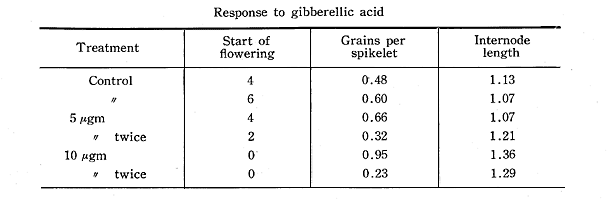
The correlation coefficient for initial dose and start of flowering was
-0.92, and the correlation was lower for the later flowers; for the fifth
flower it was -0.69. The production of grains in the glumes (Wright, in
press) was not affected, but the effect on the total fertility of the
plants was marked. Although the numbers of well-developed spikelets on
the plants were similar, ranging from 109 to 131, the plants treated once
were more fertile, and those treated twice were much less fertile than
the controls (see the table).
No response in plant height or stem internode lengths, or in the density
of the base of the ear, was established. It is probable that the treatment
was too late to affect the rachis development of the early ears, but it
is possible that the density of some of the later ears was affected, as
shown in the table. The correspondin internode lengths for "average" ears
of T. compactum and T. vulgare were 1.36 and 4.14 mm, and
although the response to gibberellic acid in the compactoid wheat is doubtful,
it does not, even if it is real, represent any substantial change towards
normality.
(Received May 2, 1958)