M.B. KUMBHAR, A.S. LARIK, H.M.I. HAFIZ* and M.J. RIND
Department of Plant Breeding and Genetics, Sind Agriculture University Tandojam, Pakistan.
Breeding high yielding varieties of crop requires information on the nature and magnitude of variation in the available material, association of characters with yield and among themselves and the extent of environmental influences on these characters. Correlation coefficient has been used to identify the grain yield components (LARIK, 1978; SIDDIQUIet al. 1980) but the technique of path coefficient analysis measures the direct influence of one variable upon another and permits the separation of the correlation coefficient into components of direct and indirect effect (DEWEY & LU, 1959; LARIK,1979) which can successfully be employed in formulation of meaningful selection strategies.
Material and Methods
Homogeneous seeds of Triticum aestivum L. (2n=6x=42=AA BB DD) cv. Nayab were grown during Rabi 1980-81 at the Botanical Garden, Sind Agricultural University, Tandojam, Pakistan. Seeds were sown in five rows each 6 m long with 30 cm interrow distance. Observations were recorded on 60 index plants selected randomly. The following characters were measured: X1=Spike length, X2=Spikelets per spike, X3=Seeds per spike, X4=Yield per spike, Y=Yield per plant (dependent character).
Correlation and path coefficients were calculated by he technique outlined by DEWEY & LU (1959) in which the end product
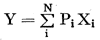
Component of correlation
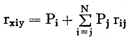
which indicate direct as well as indirect effect of one variable through another one on the end product. Multiple correlation and partial regression was calculated by using the formula suggested by STEEL & TORRIE (1960).