
The data obtained for each trait on the basis of single
plants and were analyzed on a plot mean basis by the
analysis of variance. Significance differences was
determined by F-test.
Percentage of mid-parent heterosis (MP) was computed as
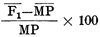 .
.
Similarly, percentage of high-parent mean heterosis (HP) was
determined as  .
.
Estimates of general and specific combining ability were
obtained by employing partial modified diallel cross method
developed by MATZINGER and KEMPHRORNE (1956) in which one
set of F1's are included.
Results and Discussion
Heterosis:
Heterosis percentages, deviation of the F1 means
from the mid-parent values as well as over better parent was
used to estimate the preponderance of dominant gene effects,
acting in one direction, at loci by which the parental
complements differ. The data for different traits based on
means of midparent (MP) and higher parents(HP) are shown in
Table 1.
Observable heterosis significant mean a sets of genes
indicates dominance of the individual genes preponderantly
in the same or in reverse direction; but no significant or
zero heterosis does not necessarily mean absence of
dominance.
Days to heading and spike density in the F1
showed a highly significant tendency to be lower than the
parental mean value and heterosis percentage -3.51 for days
to heading and -3.59 for spike density. Thus amongest the
parents of the diallel there were present gene sets for
controlling heading date and spike density at a loci by
which the parents are differed.
For the characters plant height, spike length and number of
spikelets per spike the mean F1 value was either
greater than or equivalent to the parental mean. An analysis
of variance for grain yield in the F1 was carried
out (AL-SAHEAL & GAMIL) which indicated significant
differences between lines, both parental and F1,
for its expression.
It can be concluded from the previous results that there are
no useful heterosis observed in these materials or, at
least, was not of economical usefulness.
Similar results was obtained for days to heading by
ROSENQUIST (1931), CLARK & HOOKER (1926), JOHNSON et
al. (1966), AMAYA et al. (1972), and BHATT
(1972). The results of plant height are in agreement with
that reported by GRANHALL (1946), GANDHI et al.
(1961), STUBER et al. (1962), JOHNSON et al.
(1966) and AMAYA et al. (1972).
Regarding to spike length GRANHALL (1946), SIKKA et
al. (1959) , GANDHI et al. (1961) and JOHNSON
et al. (1966) came up to similar trend of findings.
PAL & NEK ALAM (1938), SIKKA et al. (1959) and
HASSANIEN et al. (1974) found similar results in
number of spikelets per spike.