A.S. LARIK
Department ot Botany and Plant Breeding, Sind Agricultural University, Tandojam, Pakistan
Complex character such as grain yield is polygenic (BHATT, 1973; DEWEY and LU, 1959 ; LARIK, 1978) and is greatly influenced by environmental factors (KHERADNAM and NIKNEJAD, 1974). Adequate knowledge of interrelationship of factors influencing such complex character is essential for designing an effective plant breeding programme (WORLEY et al., 1976). Studies of correlations of agronomic and morphological characters are helpful in the identification of the components of a complex character such as yield but they do not provide precise information on the relative importance of direct and indirect influences of each of the componential characters (LARIK, 1978). Thus with increasing number of variables it becomes essential to measure the contribution of various variables to the observed correlation and to partition the correlation coefficient into components of direct and indirect effects (PANDEY and GITTON, 1975).
Path coefficient analysis provide an effective means of partitioning correlation coefficients into unidirectional pathway and alternate pathways. The analysis thus permits a critical examination of specific factors that produce a given correlation and can be successfully employed in formulating an effective selection strategy. The technique of path coefficient analysis developed by WRIGHT (1921) has been extensively used by conventional breeders (BHATT, 1973 ; JAIN et al., 1975 ; LYRENE and SHANDS, 1975) and most probably is being employed first time by a mutation breeder. The present paper elucidates the interrelationship of factors influencing grain yield of the mutants isolated at this University through path coefficient analysis.
Material and Methods
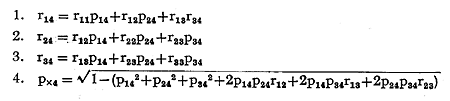
The material originated from the gamma rays and ethyle methane sulphonate (EMS) treatments of three cultivars C-591 (Locally bred), Nayab and Indus-66 (Meixcan origin) of bread wheat Triticum aestivum (2n=6x=AABBDD=42). Fifteen phenotypically stable mutants classified on the basis of grain yield in M9 generation (Table 1) and three mother cultivars were grown during Rabi 1977-78 in a randomized block design with four replications at Sind Agricultural University, Tandojam, Pakistan. Homogeneous seeds of these mutants and cultivars was drilled in single row each 300.5 cm long with 30.5 cm row to row and plant to plant distance. The data were collected on 10 randomly selected plants in each replication for four quantitative traits. Thus 40 plants were studied from each mutant and mean values of each mutant were used for calculating phenotypic correlations which were partitioned into path coefficients using the technique outlined by DEWEY and LU (1959). This technique involves partitioning of correlation coefficients to determine direct (unidirectional pathways 'P') and indirect influences through alternate pathways (pathways 'P' x correlation coefficient 'r') of various variables and grain yield. Grain yield was considered as the resultant variable. The path coefficients were calculated through the solution of the following equations.