Segregation pattern in one disomic and nineteen monosomic F2 populations of the crosses of the disomic and monosomic lines of pubescent variety Pb. C591 with glabrous variety UP 301 are presented in Table 1. When a 3 pubescent: 1 glabrous glume ratio was applied, several monosomic populations showed significant deviations. Therefore, 189 : 67 ratio which is very close to 3 : 1 ratio was applied to all the populations. Only three crosses involving chromosomes 6A, 6D and 7D of UP 301 showed significant deviation indicating the presence of gene/s for glabrousness on these chromosomes. This ratio results from the interaction of four genes, of which one is basic gene for pubescence and other three are complementary duplicate genes to the basic gene. Supposing that A is the basic gene for pubescent glume and genes B, C and D are complementary duplicate genes to A, then the ratio can be explained as follows.
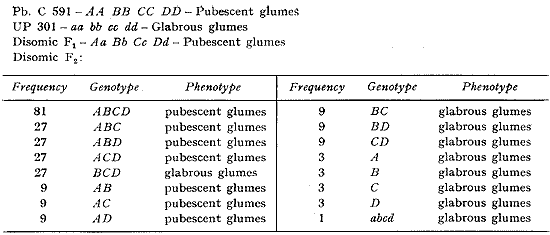
In the critical cross involving gene a from UP 301 we should expect all the plants to be of glabrous phenotype since the basic gene for pubescent glumes is in recessive condition. This was found to be so in the monosomic population for chromosome 6A where all 67 plants showed glabrous phenotype. F1's between the monosomic line 6A and UP 301 had glabrous glumes. Therefore the basic gene for glabrous condition in UP 301 was found to be associated with chromosome 6A.
In the critical cross involving gene b from UP 301 only the class 9AB showing pubescent phenotype in other crosses will show glabrous phenotype, while the rest of the classes will be unaltered in phenotype. Thus instead of 189 : 67 ratio, a ratio of 180 : 76 will be seen. Similarly in critical crosses involving other two complementary recessive genes c and d 180 : 76 ratio will be noticed. In monosomic popultions 6D and 7D the ratio of 180 : 76 fitted well x2=1.7 and 1.55 respectively, thereby confirming the presence of complementary recessive genes on 6D and 7D of UP 301. However, the third complementary recessive gene of UP 301 was not detected in the present study, but it may be present on one of the chromosomes 1A or 4A which were unfortunately missing. Thus the present investigation does not agree with the findings of earlier workers which reported a single dominant gene on chromosome 1A controlling this trait (TSUNEWAKI, 1961, KUSPIRA and UNRAU, 1960, ANDERSON and MCGINNIS, 1960) but detected a recessive gene for glabrousness on chromosome 6A of UP 301, in addition to two recessive complementary genes for glabrousness on chromosomes 6D and 7D of UP 301.
Segregation pattern for awn colour in one disomic and nineteen monosomic F2 populations is presented in Table 2. The female parent Pb. C591 has black awns as against UP 301 which has brown awns. In the disomic F2 population 57 brown : 7 black awn ratio was found to fit well. When this ratio was applied for all the monosomic F2 populations, populations monosomic for chromosomes 6A, 2B and 1D showed highly significant deviations while those of 3B and 5B registered significance at five per cent level only. Here one independent and two complementary genes were assumed to control brown awns. In the F2, segregation will occur in various populations as indicated below.