E. R. SEARS
U. S. Department of Agriculture and University of Missouri, Columbia, Missouri, U.S.A.
Because of the recent suggestion of Sarkar and Stebbins (1956) that the B genome is derived from one or more species of the Sitopsis section of the genus Aegilops, it seems desirable to make available some observations from 1941-43 on certain hybrids involving Ae. bicornis (Sb), Ae. speltoides var. ligustica (Ss), T. monoeoccum (Am), and T. dicaccoides (AB).
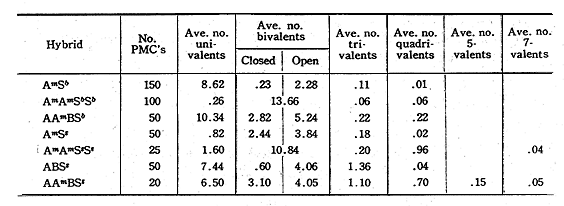
Entries 4, 5, and 6 in the table are from previous publications (Sears 1941 and McFadden and Sears 1947). The Ss genome in AmAmSsSs and AAmBSs is from strain II of Ae. speltoides, while the one in AmSs and ABSs is from strain I, but it is doubtful that significant chromosome differences exist between the two strains. Strain II showed relatively little pairing in AmSs, but the numerous multivalents in AmAmSsSs indicate strong homology of Am with Ss from strain II.
It appears that Sb has considerable pairng affinity with B, for AAmBSb averaged almost 9 pairs br its equivalent (a maximum of 12 pairs), whereas AAmB has only 5 or 6 pairs (maximum 7), according to various workers. Presumably BSb pairing accounts for about 3 or 4 pairs, which is more than were observed for AmSb.
Ss, on the other hand, apparently has more affinity for A than for B. AmSs had the equivalent of 6.59 pairs on the average,which is almost full pairing. The large amount of association in AAmBSs, equaling almost 11 pairs (maximum 13), would suggest much pairing of B with Ss, except that pairing of Ss with A and Am, as well as of A with Am and B with Ss, must have occurred. It is therefore unlikely that Ss has as strong affinity for B as for A. Whether B is closer to Ss Or to Sb cannot be decided from these data.
The phenotypes of AmAmSbSb and AmAmSsSs are such that McFadden (personal communication; 1941) was led to write. " The gross morpological characters of the hybrid Ae. bicornis x T. monococcum are the same as those of T. dicoccum, which is also true for the hybrids of Ae. speltoides ligustica x T. monococcum. " Of the two amphidiploids, bicornis-monococcum (s. figure on the cover) resembles T. dicoccum more closely. Neither amphidiploid set selfed seed in its hybrid with dicoccum.
In the early 1940's McFadden believed that the B genome of T. dicoccum had originated from Sb or Ss, as shown by his reference in 1942 to "may theory that the first cultivated emmers were amphidiploids of T. monococcum with either Ae. speltoides or Ae. bicornis." However, he also thought that the B genome of T. palonicum had come from Haynaldia villosa and the B of the progenitor of T. persicum from Agropyron triticeum. When he became aware that the chromosomes of the different supposed B sources were too diverse to account for the good pairing in hybrids among the various tetraploids, he decided that A. triticeum was the most probable single source, since it alone could account for to him extremely important free-threshing character. Recent evidence suggests that the gene for free threshing (Mac Key's Q) may simply have arisen as a mutation.