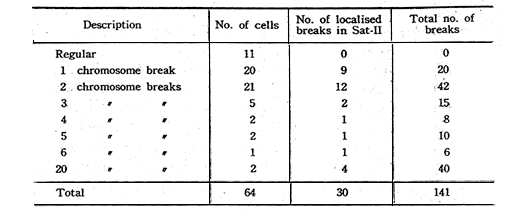
The total length of the somatic complement in T. monococcum was calculated to be 172.2 micro of which the length of the Sat-II pair was 20.8 micro. If we assume complete random breakage, approximately 1 in every 8.3 breaks could occur in the Sat-chromosomes. The observed figure of 30 out of a total of 141 breaks does not, fit with this expectation (X2=11.30; P=0.01). This would suggest that the region near the super-numerary constriction of Sat-II chromosomes is preferentially disposed to breakage by neutron radiation. It is not possible, to determine by microscopic observations whether the breakage occurs only in one chromosome of the Sat-II pair. Only 2 among the 28 cells in the Sat-II breaks showed breakage in both the chromosomes (P between 0.05 and 0.02). thus indicating that breakage occurs in only one chromosome of the pair, and not at random in either of them. The occurrence of single Sat-II break in most of the cells suggest, that some degree of differentiation, with reference to localised neutron sensitivity, may occur in the apparently homologous chromosomes.
There was no evidence for the occurrence of localised chromosome breakage in Sat-II or any other chromosomes of T. monococcum in material treated with X-rays or 32P. The localised break in fast neutron treated seeds, therefore, appears to be a correlated consequence of the interaction between the reactions set in motion by the neutron particles and the concerned chromosome segment. There was no evidence in our monococcum material that the concerned segment is heterochromatic. From this practical point of view, the occurrence of localised chromosome breakage is of interest since detectable mutation resulting from such a structural change may be expected to recur. The results of Prof. Gustaffson, in which erectoid mutants in barley occurred most frequently when dry seeds were treated with thermal neutrons, are probably attributable to some such mechanism.