A. KISS
Agricultural Experimental Institute of Duna-Tiszakoz Kecskmet, Hungary
Triticales are in general self-pollinating, but cross pollination may occur in 61-0%. When cultivating Triticale No. 64 (2n=6x=42) and Triticale Rosner (2n=6x=42) of Canadian origin close together in 1968 and 1969 we found even more spontaneous crossing Triticale Rosner was first sown in the nursery of the Experimental Institute of Kecskemet on 7. February 1968. The grains harvested were sown in a sheltered plot on 8. October of the same year. Five rows of the Canadian Triticale were margined on both sides by five rows of Triticale No. 64. Vegetation period for both of them is as follows:
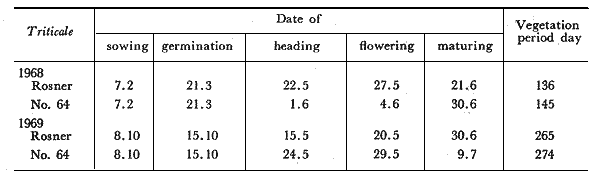
When analysing growth stages it appears that Triticale Rosner flowers 8-9 days earlier than the Hungarian winter type (half-winter type) Triticale. For all that Triticale No. 64 begins to flower when Triticale Rosner is in full bloom and has its main flowering period at the second bloom of Triticale Rosner (flowering of tillers).
As Triticale Rosner is 30 cm shorter than Triticale No. 64, at flowering time it was abundantly supplied with fresh pollen from the taller Triticale. The extent of crossing could not be determined by examining the grains, however, it was easy to detect spontaneous crossing in F1 plants. Namely, when hand crossing, the F1 hybrids of crosses between Triticale Rosner and Triticale No. 64 are easily recognizable by some dominant marker characteristics such as
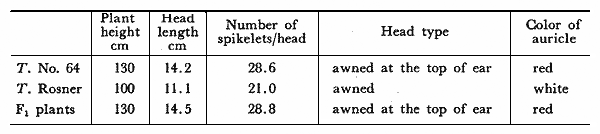
In 1968 about 7000 grains of Triticale Rosner were harvested, out of which 5 times 200 grains were sown on 8. October 1968. From these 710 plants were cultivated. From the 710 plants there were 146 which had the height, red auricles and head type of No. 64, that is, they were spontaneous F1 plants (20.56%). The extent of spontaneous crossing is remarkably high, showing that Triticale Rosner flowers fairly open in Hungarian conditions. From hand pollination between Triticale Rosner and Triticale No. 64, made simultaneously, 24.3% seed set was obtained in 1968 and 18.1% in 1969. Reciprocal cross was only made in 1968 with a seed set of 16.6%.
The pedigree of Triticale Rosner is fairly complicated. Among its parents Triticum durum has a dominant part Triticum Rosner (Triticum durum cv. GHIZA x Secale cereale) x (T. durum cv. Carleton x S.cereale) x (T. persicum x C.cereale) x (a Triticum-Secale Introduction). The basic material of Triticale No. 64 is Triticum turgidum; the pedigree is shown in No. 31. of WIS, 1970.
It is to hope that due partly to the considerable extent of spontaneous crossing and partly to purposeful hand pollination and selection some new and more valuable types can be developed suitable for practical field production.
(Received March 25, 1970)