B. C. JOSHI, M. D. UPADHYA1) and M. S. SWAMINATHAN
Indian Agricultural Research Institute, New Delhi-12, India
In a comparative study of the meiosis in 41- and 42-chromosome hybrids between Chinese Spring monosomic for chromosome 5B and Triticum zhukovskyi, UPADHYA and SWAMINATHAN (1965) found that the number of chromosomes entering into associations increased in 41-chromosome hybrids where 5B of Chinese Spring was absent. On the basis of these findings it was suggested that the genetic mechanism, similar to that found on the chromosome 5B of Chinese Spring (Triticum aestivum), might not be present in T. zhukovskyi. It was also suggested that T. zhukovskyi, a natural autoallohexaploid, which presumably arose from the cross T. timopheevi x T. monococcum (UPADHYA and SWAMINATHAN 1963), T. timopheevi also lacks the gene system of 5B of T. aestivum. This paper deals with a comparative study of meiosis in the 34- and 35-chromosome hybrids of the cross between mono-5B of chinese Spring and T. timopheevi.
Triticum aestivum sub sp. vulgare var. Chinese Spring, monosomic for chromosome 5B (2n=41) was crossed with T. timopheevi ZHUK. (2n=28) and in the F1 meiotic metaphase I was studied in the 34- and 35-chromosome hybrids. It was observed that the chromosomes which entered associations as trivalents, quadrivalents and pentavalents were more in the 34-chromosome hybrid than in the 35-chromosome one. These differences in the multivalent associations were found to be statistically significant. This shows that chromosome 5B of T. timopheevi, equivalent to 5B of Chinese Spring is unable to supress pairing of homoeologous chromosomes to the degree controlled by 5B of Chinese. This, therefore, indicates that chromosome 5B of timopheevi does not possess a gene system similar to that located on 5B of T. aestivum.
FELDMAN (1966 a) studied chromosome pairing in the 41- and 42-chromosome hybrids between Chinese Spring mono-5B and amphidiploid of the cross T. timopheevi x Ae. squarrosa and suggested that since the mean pairing values were similar in the two types of hybrids, the timopheevi chromosome which corresponds to 5B of Chinese Spring compensates completely for the nullisomic condition of 5B of Chinese Spring and, therefore, timopheevi contains a gene system on this chromosome identical with that found in chromosome 5B of aestivum. Since the present data support the findings of UPADHYA and SWAMINATHAN (1965), it is worth while re-examining the evidence presented by FELDMAN (1966 a).
The genomic constitutions of T. zhukovskyi, timopheevi-squarrosa amphidiploid and the two types of 41-chromosome hybrids of these with mono-5B of Chinese Spring, with respect to the homoeologous group 5, are tabulated below.
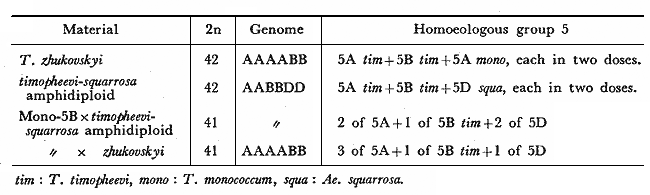
FELDMAN (1966 b) has shown that with respect to pairing, four doses of 5A compensate for the nullisomic condition of 5D in the presence of two doses of 5B in Chinese Spring. Further, according to him, tri-5A mono-5D along with atleast one dose of 5B of aestivum (since 5B is haplo sufficeint) should, therefore, have normal synapsis. But the 41-chromosome hybrid between mono-5B and T. zykovskyi (Table) having one dose of 5B from T. timopheevi with tri-5A + mono-5D, had shown increased chromosome associations; whereas 41-chromosome hybrid between mono-5B x timopheevi-squarrosa amphidiploid having one dose of 5B from timopheevi with di-5A + di-5D, had shown normal pairing. It is thus clear that one dose of 5D was unable to complement the 5B of timopheevi, but two doses of 5D were able to complement 5B of timopheevi to bring about normal pairing.