W. GOTTSCHALK and M. IMAM
Institute of Genetics, University of Bonn, Germany and University College, Cape Coast, Ghana
Introduction
An extensive work has been done during the past decades concerning the relations between radiation susceptibility and level of ploidy in the genus Triticum, but the problem is not yet solved. Numerous contradictions can be found in the literature and it is possible to confirm each hypothesis theoretically conceivable by empirical findings. Many authors found an increasing radiation susceptibility of the diploid species in comparison to the polyploid ones (FROIER 1941, FROIER and GUSTAFSSON 1941, NATARAJAN, SIKKA and SWAMINATHAN 1958, MATSUMURA and NEZU 1960, BHASKARAN and SWAMINATHAN 1961). In contradiction to this, some varieties of the diploid Triticum monococcum studied by SMITH (1946) turned out to be more resistant than the tetra- and hexaploid material. Divergent findings were also obtained by comparing tetra- and hexaploid species. In some cases, no clear differences were found (FROIER, GELIN and GUSTAFSSON 1941, SMITH 1946, NATARAJAN, SIKKA and SWAMINATHAN 1958, BHASKARAN and SWAMINATHAN 1961). Different authors, however, observed an increased radiation resistance of the tetraploid material in comparison to the hexaploid one (MATSUMURA, FUJII and KONDO 1957, MOHAMED 1962). The opposite behaviour was found by MATSUMURA and NEZU (1960) with regard to T. durum and T. vulgare. Finally, certain investigations show a differing susceptibility of species or varieties belonging to the same level of ploidy (FROIER 1946, MATSUMURA and FUJII 1955, MATSUMURA 1956, SARIC 1958, SCARASCIA et al. 1960). The heterogenious findings obtained are easily understandable if one assumes, that not the degree of ploidy, but the genotypic composition of a species, subspecies or variety is responsible for its reaction to radiation. In order to prove this hypothesis, several species and varieties of each of the three ploid groups of the genus were used studying their radiobiological and radiogenetic behaviour.
Material
The following varieties were used for our investigations:
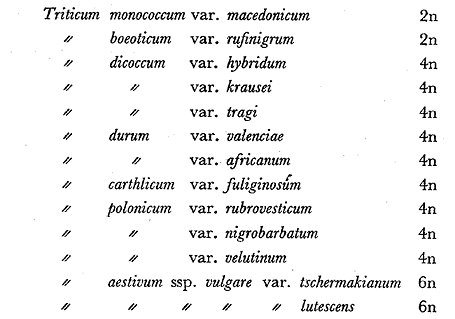
Dry seeds were irradiated with 10, 12.5, 15, 17.5, 25 and 32.5 kr X-rays. A dosage of 17.5 kr was lethal for most of the varieties used. Different criteria showing the radiobiological response were studied in X1-plants grown in the field. The mutation frequency of the X2-generation was preferably studied in the greenhouse by evaluation of chlorophyll mutations.