KOZO NISHIKAWA
Faculty of Agriculture, Gifu University, Gifu, Japan
Telocentric chromosomes are very useful for cytogenetical investigation. OKAMOTO (1962) and CHAPMAN and RILEY (1966) used them for the identification of pairing chromosomes, and SEARS (1962) for the determination of gene-centromere distance.
OKAMOTO (1961) reported about T. durum with a telocentric for the long arm of chromosome 5A introduced from Chinese Spring by successive backcrosses. He provided the present author with seeds of F1, BC1, or BC2 between respective telocentric lines of Chinese Spring for 1A long, 2A right, 3A right, 2B right and 3B long, and T. durum (LD 222) as a backcross parent. In addition to these, 22 telocentric lines of Chinese Spring for the A and B genome chromosomes, provided by Dr. E. R. SEARS were used for crosses to LD 222.
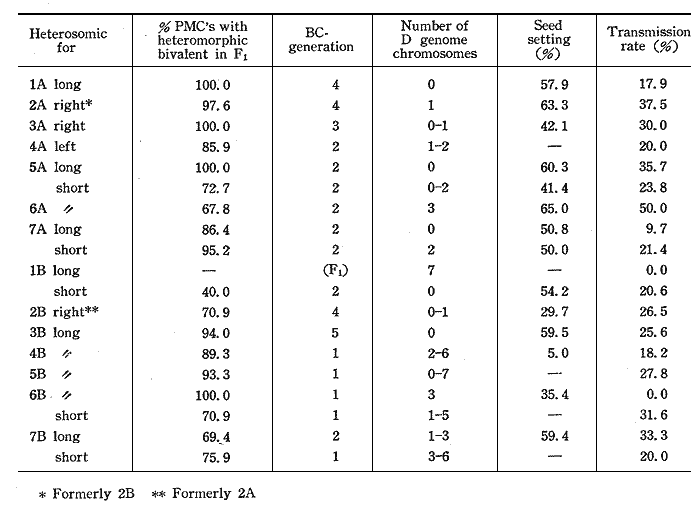
Chromosome pairing in 18 lines of pentaploid F1 which carry the respective telocentric chromosome in heterosomic condition was found to be mostly regular with exception of very rare multivalents and precocious desynapsis of some of the heteromorphic bivalents. As the table shows, 1A long, 3A right, 5A long and 6B long showed complete pairing, while 1B short was desynaptic in 60 per cent of PMC's in F1 and to a considerable extent in BC2.
Seed setting on the backcrossed spikes varied depending on the telocentric involved. The percentages, however, should not be considered as conclusive because seed setting may be more or less improved if the D genome univalents are eliminated.
Transmission rate of telocentrics also varied. From the values, given in the table, 20-30 per cent of transmission rate can be expected for most of the lines tested. However, it should be noted that the telocentric for 1B long and that for 6B long, both being deficient for the long arm carrying the nucleolar organizer, were extremely low in transmission rate; 1B long was not transmitted from F1 to BC1, nor 6B long from BC1 to BC2. Contrary to expectation, all plants heterosomic for 2A (II) right have kept without exception an extra chromosome for three generations. It is presumably 2D, because it rarely paired to form a trivalent including 2A (II) right.
The plant heterosomic for 1A long and that for 3B long, both being free from D genome univalents, gave rise to the ditelocentrics for the respective arm by self-pollination. One ditelocentric for 1A long was highly male sterile and set no seed by self-pollination, whereas the other ditelocentric for 3B long was seedling lethal.
As described above, 19 out of the possible 28 telocentric lines in tetraploid wheat were investigated, the lacking nine lines remaining for further study. As to those 19 lines reported here, more backcrosses are necessary in order to eliminate the D genome univalents and/or to make the background homozygous. Also the new telocentric chromo somes which have not yet been isolated must be found, i. e. 1A short, 2A (II) left, 3A left, 6A long, 4B short and 5B short.
Chromosome pairing, fertility and transmission rate in F1 and backcrosses in 19 telocentric lines of Chinese Spring for A and B genome chromosomes and Triticum durum LD 222 :
(Received June 26, 1967)