By H. SUEMOTO and K. KOJIMA
Lab. Genet., Kyoto Univ., Kyoto
1. Description of the right- and left-handedness as a quantitative character:
Right-handed and left-handed leaves are defined according to the way of folding, namely when the overlapping edge of a leaf, seen from outside, is on the right hand of the observer, it is called right-handed, and if on the left hand, left-handed. Correspondingly, the right- or left-handedness of a spikelet is determined by the position of the first floret in the spikelet. Namely, a spikelet seen from its dorsal side is right-handed, when the first floret is on the right, and left-handed when it is on his left hand (KlHARA et al. 1951). The right-handed and left-handed leaves are regularly arranged in alternative sequence from the base up to the flag leaf and the same regularity is found in the spikes. The regularity is not always complete, deviations occur often in the upper part of spikes and in the lower positions of leaves (such as the 1st, 2nd and 3rd leaves). The regularly arranged leaves or spikelets are called "concordant" and the deviating "discordant".
2. Measurement of the right- and left- handedness ...... Concordance proportion (C) and mean concordance proportion (C):
A. Concordance proportion ...... If a variate Xi is assumed to have the value 1 in case of a concordant leaf or spikelet and 0 in that of a discordant one, the concordance proportion of the kth position of leaf or spikelet (Ck) is
 where n is
the number of shoots investigated.
where n is
the number of shoots investigated.The expected standard error of Ck is

This value represents the degree of the regularity or the intensity of the polarity at the given position on the stem (SUEOKA and MUKAI 1955).
B. Mean concordance proportion ...... The use of the concordance proportion was frequently found to be inconvenient as a measure of species differences with regard to the right- and left-handedness and troublesome in its genetic analysis. KOJIMA (1953), therefore, proposed a more convenient value,i.e. mean concordance proportion (C). The value is expressed by
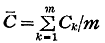 where
Ck is the value of concordance proportion at the kth
spikelet position and m is the number of spikelets. The sampling
variance can be obtained as follows:
where
Ck is the value of concordance proportion at the kth
spikelet position and m is the number of spikelets. The sampling
variance can be obtained as follows: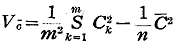
3. Change of the degree of regularity throughout the developmental stages:
We have considered that the regularity of the R/L character might be interpreted as an expression of polarity existing throughout the whole development of a grass. An exact observation on the R/L handedness of the leaves and spikelets from the first foliage leaf to the 20th spikelet was made for T.monococcum flavescens (Table 1).
The results indicate that the regularity appears at the 3rd or 4th leaf's position, is maintained to the 10th spikelet or its vicinity and disappears around 20th spikelet.