The 1963 C S S A Committee on Crop Terminology reports on (a) terminology for cytoplasmic male - sterility in field crops, and (b) other crop terminology.
Cytoplasmic Male - Sterility
Terminology involved in cytoplasmic male - sterility in various field crops is being emphasized in the current report of the C S S A Committee on Crop Terminology. Emphasis is placed on the terms used in corn, sorghums, and sugar beets in an attempt to standardize designations for different field crops, so far as possible.
Indian Corn or Maize (Zea mays L.)
Cytoplasmically induced male - sterility in corn, commonly termed "cytoplasmic male sterility" or "cyto - srterility", is caused by an interaction between cytoplasm and nuclear genes. Two types of male - sterility - inducing cytoplasm are known: The Texas or "T" type and the U S D A or "S" type. All other dlscoveries of male - sterile cytoplasm to date appear to be indistinguishable from either "T" or "S".
The genetic symbols in common use are as follows:
cms: A cytoplasm that induces male sterility. This symbol may carry subscripts 1 to n, to denote specific cytoplasms.
Rf, rf: Genes that affect pollen fertility restoration. These are given subscripts to denote different loci. Occasionally, they have also been given superscripts to designate the appropriate cytoplasm, but this practice is not general.
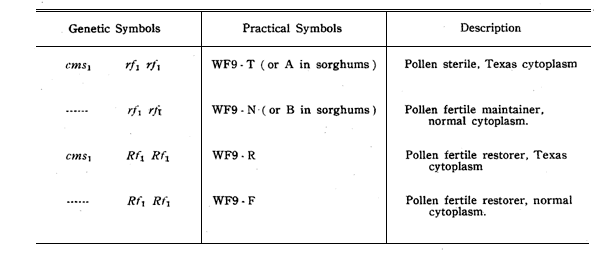
Rf1 is the most important locus, for commercial use. In the presence of Texas cytoplasm (cms1) Rf1 Rf1 and Rf1 rf1 are pollen fertile, while rf1 rf1 is pollen sterile. Modifiers of unknown number and location affect the expression of Rf1.
Corn breeders use a slightly different practical system of terminology, based primarily on the phenotype, to label inbreds used to produce hybrids. The cms term is replaced by a T or S to indicate the Texas or U S D A source of cytoplasm. Thus, when the subscript is used for the Texas source, the two usages for WF9 inbred would be as follows: cms WF9 and WF9 (T). Rather general use is made of Rf and rf (Usually refers to Rf1 and its effect in cms1).
It would seem to be simpler (for routine commercial use) to use a single letter to designate the four possible homozygous states of an inbred with regard to a single cytoplasm as follows: