F. D'AMATO, G. T. SCARASCIA MUGNOZZA and A. BOZZINI
Istituto di Genetica dell'Universita, Pisa and Laboratorio per le Applicazioni in Agricoltura, C. N. E. N., Roma. Italy
Since 1956, experiments were carried out on the induction of mutations in durum wheat (varieties: Aziziah, Cappelli, Russello) by X - rays, fast neutrons, thermal neutrons, ethylmethanesulphonate, diethylsulfate and ethyleneimine. So far 396 independently obtained cases of viable mutations have been isolated; moreover, several hundreds of lethals are being maintained as heterozygotes.
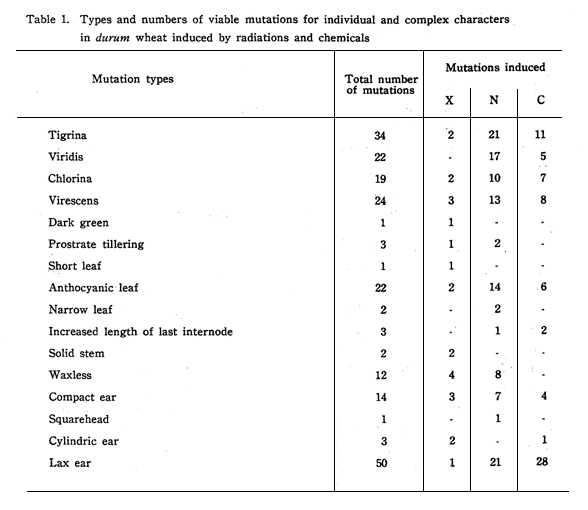
As shown in the accompanying table, the 395 mutations available involve either single or several characters (complex phenotypes); they constitute a valuable material for both theoretical and applied research.
Among the mutations listed, the following three appear to be of an evolutionary interest, namely:
1) "vavilovoid", characterized by an increased number of nodes and strong elongation of the internodes in the rachilla, heading to a pseudo - branched spike; this character, resembling the pseudo - branched spike of the hexaploid Triticum vavilovii, behaves as a simple recessive;
2) "supernumerary spikelets" (elymoides), showing 3 to 7 spikelets on each rachis node instead of one, as normally in Triticum. Also this character behaves as a simple recessive;
3) "solid stem", characterized by pith - filled culms; this mutation, showing a semi - dominant type of inheritance, is regarded to result from a deletion of the gene MB for hollow stem, which is epistatic, only when homozygous, on one or more genes inducing stem solidness (BOZZINI and AVANZI, 1962 Caryologia, 15: 525-535).
As to mutations of possible agronomic value, good promise seems to offer mutations for short straw, higher lodging resistance, increased spike and spikelet fertility.
Large - scale field trials for an agronomic evaluation of some of the induced mutants have been greatly facilitated by the establishment, in 1960, of a Research Group on durum wheat under the sponsorship of the Italian Research Council. The group includes, besides our Laboratories, the following Institutes: Institute of Cereal Genetics of the Ministry of Agriculture, Rome; Institute of Plant Pathology of the University, Bari and the Institutes of Agronomy of the Universities of Bari, Palermo and Sassari. The field trials conducted in the last three seasons in several localities of the Southern and Central Italian peninsula, in Sicily and Sardinia have shown that some mutants manifested a good performance in most trials, reaching in some of them significantly higher yields than those of the mother line (Cappelli).
The genetic and cytological analyses carried out so far on the mutant collection have shown that:
1) in a total of 51 mutations studied, 41 behaved as monogenic recessive, 2 as semidominant and the remaining 10 showed segregation ratios lower, or much lower, than 25%, in connection with different sterility degrees;
2) analysis of meiosis in M3 and M4 mutant progenies as well as in the F1 of the cross "mutant x mother line" revealed the occurence of a reciprocal translocation in 25 out of 52 mutations investigated (MARTINI, Genetica Agraria, in press).
Our work on experimental mutagenesis and on the cytogenetics of induced mutations in durum wheat is being continued.