M. SASAKI
Laboratory of Plant Breeding, Faculty of Agriculture, Tottori University, Tottori, Japan
At the Second Wheat Genetics Symposium (Japan), the present author presented some experimental results of the analysis of various chromosome substitution types obtained from wheat-rye hybrids. He also reported on crosses between those substitution types and wheat monosomic lines. In addition, some new procedures, that might be used in wheat-rye breeding, were formulated.
There are three types of wheat-rye hybrids, namely, amphidiploids, heteroploids (including addition types) and substitution types. From the practical viewpoint, however, the substitution type is the most promising material for breeding especially for transferring a useful gene or genes from rye to wheat.
The substitution lines can be classified for convenience's sake into the following four types;
| 1. Gene substittution type | |||
| 2. Chromosome substitution type | |||
| a. Single chromosome substittution type | |||
| b. Multiple chromosome substitution type | |||
| 2-chromosome substitution type | |||
| 3-chromosome substitution type | |||
| . . . |
|||
| n-chromosome substitution type | |||
| 3. Genome substitution type | |||
| 4. Nucleus substitution type | |||
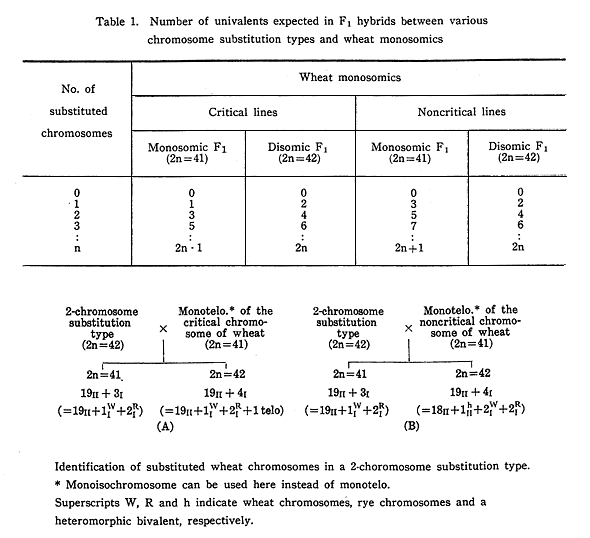
For systematic production of all the theoretically possible 147 lines
of single chromosome substitution lines, the procedure described by JENKINS
(1956) is recommended. If, however, a series of wheat-rye substitution
lines is already available, a new series of substitution lines can be
established after a procedure indicated below.
As an example of using wheat aneuploids in the study of wheat-rye hybrids,
a method of monosomic analysis, that is now under way for a gene (or genes)
controlling the crossability between wheat and rye, is shown in Table
2. This method is based on the assumption that crossability is controlled
by a single or a few major genes.