Directed change in seed dormancy
period of Moskovka Spring Wheat
V. E. PISAREV and M. D. ZHILKINA
Institute of Non-Chernozem Zone Agriculture, Moscow,
U.S.S.R.
The Moskovka spring wheat variety (T. aestivum
var. graecum) has been so far standardised for
production in 18 regions and autonomous republics of the
non-chernozem zone, i.e. in an area stretching from the
Baltic to the Ural Mountains.
The Moskovka wheat is high-yielding, smut-resisting,of very
high baking quality, and resists lodging. However, together
with good qualities, Moskovka has shown an undesirable
characteristic - short post-harvest dormancy. Given a rainy
and warm autumn the variety will start germinating in the
field condition.
In working to change the heredity of Moskova variety the
period of grain forming form milky through gold to complete
ripeness was used.
In one case grain after-ripening in sheaves was subjected to
low temperature(about 0 Centigrade) and, in another case,
physiologically ripe seed was heated by immersion in hot
water (55 Centigrade) for 30 minutes. In that time the seed
swelled, absorbing over 25 per cent water to its weight,and
the caryopsis began coming out of dormancy in conditions
unusual for a germinating seed. The result in both cases was
the same, viz. a shift in the heredity of the processed seed
toward a longer post-harvest dormancy. However, on
examination, the grain that was subjected to low temperature
showed a tendency to developing a pale-pink colouring.
200 of such grains were selected and sown in vegetation
pots. Cropping was done individually, plant by plant. Out of
the 176 plants 72 yielded the typical white grain of var.
graecum, while 102 plants yielded red grain, e.
i. they were of var. erythrospermum Germination
of grain gave the following results: after twelve days 80
percent of the whitec-oloured grain germinated and only 4
per cent of the red-coloured variety.
Anatomical examination of red-coloured grain revealed that
as distinct from the parent Moskovka seed it has a
wellpronounced layer of inner integument of golden-yellow
colour. This golden layer can be clearly seen between the
colourless layer of inner integument and the inner epidermis
of the nucellus. The absence of such a pigment layer in
grain skin is a distinctive feature of the white-grain
Moskovka.
This emergence of a solid pigment layer is seen as the main
cause of a longer dormancy period in the red-grain variety.
So long as atmosphere oxygen cannot penetrate this layer
seed germination is retarded.
To achieve a quantity transformation of white-grain Moskovka
into a new, red-grain, variety the technique of "prewinter
sowing" was used. This technique envolves sowing seed a few
days prior to ground freezing, which for Moscow region falls
on the first ten days of December. Seed is required in this
case just to start germinating, which process is then
stopped by the complete freezing of the ground. This
technique is a usual practice at Soviet breeding stations to
combat smut (Ustilago tritici Jensen).
Subsequently the red-grain plants thus obtained were used as
the foundation stock to establish a new variety,
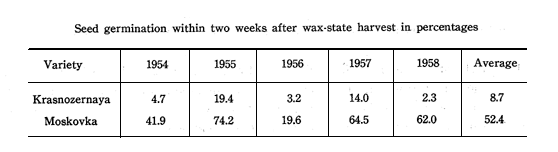
Krasnozernaya (Red-grain). The following table gives the
data on the retarded germination of the new variety obtained
in the course of five years.
It should be noted that the new variety has retained the
high baking quality of the parent variety and in a number of
non-chernozem regions has considerably surpassed it in
yields.
Morphologically the new variety, Krasnozernaya has no
difference.
This transformation of a white-grain variety into a
red-grain variety is seen as a process of mutation caused by
temperature shock.