M. P. BHATNAGAR, R. P. CHANDOLA and A. K. SANGHI
Government Agricultural Research Farm, Durgapura, Jaipur, India
During the mutation genetics programme in bread wheats the seeds were treated with pile neutrons from Atomic Energy Establishment, Bombay, India. Four doses viz. 13.5 x 10¹³ np/cm2; 4.5 x 10¹³ np/cm2; 1.5 x 10 np/cm2 and 0.5 x 10¹³ np/cm2 were administered to see the genetic effects of pile neutrons on two varieties, RS 31-1 and C 591, of bread wheat. Germination percentage, growth rate of seedling, spike fertility and chromosomal aberrations, clubbing of ear and chlorophyll deficiency in the X1 and X2 variants were compared. There was no germination of X1 seeds in C 591 with 13.5 x 10¹³ np/cm2 dose. The treated plants showed general lateness in flowering, and maturity was observed to be 15 days later over control.
Doses 4.5 x 10¹³ np/cm2 and 1.5 x 10¹³ np/cm2 roughly proved to be effective in changing the germination percentage, rate of seedling growth, spike fertility, chromosomal aberrations and chlorophyll deficiency in some of the plants. The higher the dose of pile neutrons, the more delayed were germinations and the more inhibited was seedling growth.
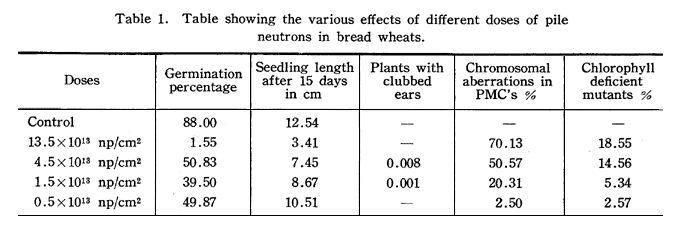
In the X2 progeny of the treated plants white and yellow seedlings were often found in 4.5 x 10¹³np/cm2 and 1.5 x 10¹³ np/cm2 treatments. These seedlings, however, did not survive for long. The frequency of chromosomal aberrations and chlorophyll deficient variants is directly proportional to the rate of dose. No difference in the various treatments due to varieties was observed. In conclusion, it may be suggested that increased dose of radiation possibly damages the embryo, and hence germination percentage was lower in higher doses.