Y. CAUDERON and B. SAIGNE
Station d'Amelioration des Plantes, Route de Pont du Chateau Clermont-Ferrand, France
In a recent paper1) we reached conclusions about the genome formulae and phylogenetic origins of some Agropyrum species based mainly on the meiotic chromosome behaviour of Agropyrum species, and of interspecific or intergeneric hybrids.
We have produced and studied the following new hybrids (hypothetical genome constitution in brackets) :
| -Agropyrum repens (L.) P.B | x Hordeum secalinum Schreb. | |
| (R1R2Z1 genomes) | (2 unknown genomes) | 2n = 35 |
| -Agropyrum junceum boreo-atlanticum (L.) S.G. | x Agropyrum elongatum (Host) P.B. | |
| (J1J2 genomes) | (E genome) | 2n = 21 |
| -Agropyrum junceum boreo-atlanticum (L.) S.G. | x Agropyrum repens (L.) P.B. | |
| (J1J2 genomes) | (R1R2Z1 genomes) | 2n = 35 |
The meiotic chromosome behaviour of the three hybrids is recorded below :
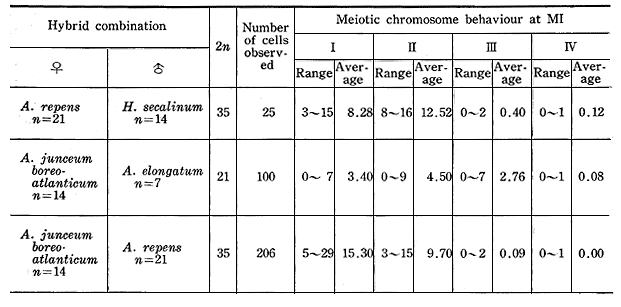
The amount of pairing is very high : 76, 84 and 56% respectively. However these hybrids are pollen and seed sterile, as are all the hybrids we have studied in this group.
Dealing with each hybrid separately it may be noticed that:
1. A. repens x A. secalinum (R1R2Z1/2 unknown genomes).
This was the only successful hybrid amongst all those attempted between Agropyrum and Hordeum species. It demonstrates the close relationship between Agropyrum and Hordeum we had previously supposed from Agropyrum repens. The good pairing at MI (with four genomes associated as bivalents) is an indication of the close homology between the chromosomes of A. repens and H. secalinum.
In addition there is probably autosyndesis between chromosomes of the R1 and R2 genomes of A. repens, but there is probably no autosyndesis between chromosomes of the H. secalinum genomes (cf. H. bulbosum x H. secalinum hybrids).2)
Consequently the Z1 Agropyrum genome and one of the H. secalinum genomes, which we shall call Z2, must be closely related.
2. A. junceum boreo-atlanticum x A. elongatum hybrid (J1J2/E).
From the high frequency of trivalents at MI, it can be concluded that there is close relationship between the J1, J2 and E genomes. Similar conclusions can be drawn from karyotype analysis.1)
3. A. junceum boreo-atlanticum x A. repens hybrid (J1J2/R1R2Z1).
This hybrid behaves very likely the natural hybrid Agropyrum acutum R. and S. The chromosome pairing observed does not weaken the conclusion about genome formula which has been proposed for both species, that is to say, homeology between J1 and J2 genomes and between R1 and R2 genomes; all the associations were autosyndetic.
It can be concluded: first, that there is probably a Z1 genome in Hordeum secalinum which is homeologous with the Agropyrum repens genome Z1, and secondly, that the E genome (A. elongatum) and the J genome (A. junceum boreoatlanticum) are closely related.