R. E. HEINER, C. F. KONZAK and R. A. NILAN
Agronomy Department, W.S.U., Pullman, Washington, U.S.A.
Treatment with a diethyl sulfate solution on barley seeds leads to high mutation frequencies; but of even greater significance is the fact that this chemical induces few chromosomal aberrations. The mutation rate, measured by the percentage of spikes segregating for chlorophyll mutants, and cytological analysis are as given in the following table.
The results and details of treatment conditions have been published elsewhere.1)
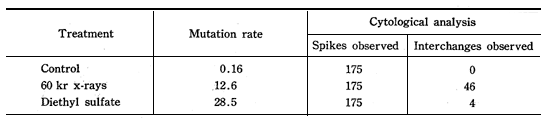
It also appears that treatments with dimethyl sulfate and ethyl methane sulfonate also yield few chromosomal aberrations.
During the past year we have treated wheat with diethyl sulfate, but as yet have no mutation data. Preliminary results indicated that longer seed treatment times were required to produce the desired seedling injury response in wheat than for barley. This may be due to the protection effect of duplicate genes afforded by the three sets of genomes in wheat, namely AABBDD.
It would seem desirable to use diethyl sulfate or other alkylating agents possessing similar characteristics for mutation breeeding where the transfer of chromatin material is not necessary or desirable.
Since diethyl sulfate has been shown to induce a high frequency of mutations at high rates of survival in both barley and bacteria, it would seem advisable to test it thoroughly with wheat.
Journal Note, Washington Agricultural Experiment Stations: This research was supported in part by the U.S. Atomic Energy Commission Contract AT (45-1)-353, in part by a grant from the Washington State Department of Agriculture. The work was carried out at Pullman, Washington, under Washington Agricultural Experiment Stations Projects 966 and 4068.