Akira MOCHIZUKI
Laboratory of Genetics, Hyogo Agricultural College, Sasayama, Japan.
Jenkins and Mockizuki (1957) produced an amphiploid T. durum-Ag. elongatum (AABBEE) from the F1 hybrid between T. durum var.. STEWART and Agropyron elongatum (2x), and in the following year, I obtained a pentaploid hybrid (AABBE) from the cross of the amphiploid with durum parent. The first monosomic addition line was obtained in the self progeny of an aneuhaploid (ABE + 1) occurred from the pentaploid hybrid. Other monosomic addition lines were successively obtained from the repeated backcrossings of the pentaploid hybrid with durum parent. Thus in 1959, a series of the seven monosomic alien addition lines was established.
The monosomic addition lines have 29 chromosomes, i.e. 28 wheat chromosomes and one Agropyron chromosome in addition. The alien chromosomes transferred from Ag. elongatum are designated as e1, e2,. . . . , and e7, respectively. An attempt was made to produce disomic addition lines in order to maintain these alien chromosomes in wheat. Consequently five disomic addition lines (28 wheat chromosomes + ee) have been obtained in the self progenies of five different monosomic addition lines (e1-e5).
However, e6 and e7 disomic lines have not yet been obtained though a large number of the progenies of the respective monosomic addition lines were examined. This might have been caused by a low transmission rate of those chromosomes through male gametes.
Phenotypes of the addition lines are different in respect with certain characters from Stewart durum, as given in the following table.
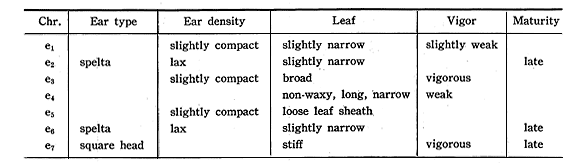
The vigor and fertility of the monosomic addition lines are not so different from durum parent, but are reduced in the disomic addition lines. There seems to be a general tendency that some phenotypes of monosomic addition lines are more exaggerated in disomic addition lines.
Disomic line e4 (e4e4) has some such conspicuous characters which were presumably transferred from Agropyron as non-waxy, very narrow long leaves, tight leaf sheath etc. Futhermore, this line is weak having virescent leaves with light yellow stripes like Ca- or Mg- deficient plants. Its fertility is about 3 per cent, while the other disomic lines show 30 to 70 per cent. These disomic addition lines are fairly stable, producing only a small proportion of progeny with deviated chromosome number.
In regard with the relationship between durum wheat and Agropyron, it is of interest to observe meiotic associations between wheat and Agropyron chromosomes in monosomic addition lines. If an alien chromosomes has no homology with any of the wheat chromosomes, the monosomic addition line shows 14II+1I , while some chromosome associations is expected between them if a homologous segment is present. Actually no chromosome associations were observed between wheat and alien chromosomes in the lines e4, e6 and e7. While trivalent associations were observed (1III + 13II) in the lines e1, e2 and e3, and trivalent or pentavalent associations (1III + 13II or 1V +12II) were frequently observed in the line e5. The pentavalent association suggests that both arms of the e5 chromosome are partially homologous with two different wheat chromosomes.
From these results, it can be concluded that four chromosomes are at least partially homologous between Stewart durum and Agropyron elongatum (2x).